Schedule a call!
A hiring manager does not usually ask for an honesty test because they want a longer hiring process.
They ask because something has gone wrong before.
A new hire stopped showing up after two weeks. A candidate looked strong in interviews but ignored basic workplace rules once hired. A location manager is dealing with theft, safety shortcuts, policy violations, or repeated reliability issues. Recruiters are moving quickly, but the company is still taking on avoidable risk.
That is where an honesty and integrity test definition and types for HR becomes useful. Before HR decides where to place the test, how to explain it to candidates, or how to use the results, the team needs to understand what the test is actually designed to measure.
An honesty and integrity test is not a background check. It is not a personality quiz in the casual sense. It is not a substitute for interviews, references, or manager judgment.
It is a structured pre-employment screening tool used to evaluate whether a candidate is likely to be honest, dependable, accountable, and aligned with workplace standards.
For HR teams that already understand the basics and want a process guide, read How to Use Honesty and Integrity Tests in Hiring. This article focuses on the definition, types, and business benefits.
What Is an Honesty and Integrity Test?
An honesty and integrity test is a pre-employment assessment designed to evaluate traits, attitudes, and behavioral patterns related to honesty, dependability, rule-following, accountability, and workplace conduct.
In plain HR language, it helps answer questions such as:
Can this candidate be trusted in the role?
Is the candidate likely to follow workplace rules?
Does the candidate show reliability and accountability?
Are there risk signals HR should review before moving forward?
Is this person likely to create preventable conduct, attendance, theft, or safety issues?
The U.S. Office of Personnel Management describes integrity and honesty tests as assessments used to evaluate whether an applicant is likely to be honest, trustworthy, and dependable. OPM also connects low integrity with counterproductive workplace behaviors such as theft, absenteeism, sabotage, disciplinary problems, and violence. OPM integrity/honesty tests.
That definition is useful because it keeps the assessment grounded in employment risk, not vague character judgment.
For HR, the test should support a job-related hiring decision. It should help the team evaluate relevant workplace behaviors before the candidate moves deeper into the process.
Honesty vs. Integrity: Why the Difference Matters
Honesty and integrity are connected, but they are not the same.
Honesty is about truthfulness. It relates to whether a person is likely to give accurate information, avoid deception, admit mistakes, and represent themselves honestly.
Integrity is broader. It includes honesty, but also includes dependability, accountability, judgment, policy adherence, respect for rules, and how someone behaves when there is pressure or temptation.
A candidate can understand that honesty is important and still rationalize small workplace violations. They may believe theft is wrong but still take safety shortcuts. They may present well in interviews but struggle with accountability, attendance, or rule-following after hire.
That is why HR should avoid treating honesty tests as a narrow “theft screen.” A strong integrity test looks at a wider set of workplace behaviors.
For a more detailed assessment-methodology view, connect this article with Honesty and Integrity Assessment for Smarter Hiring.
The Three Main Types of Honesty and Integrity Tests

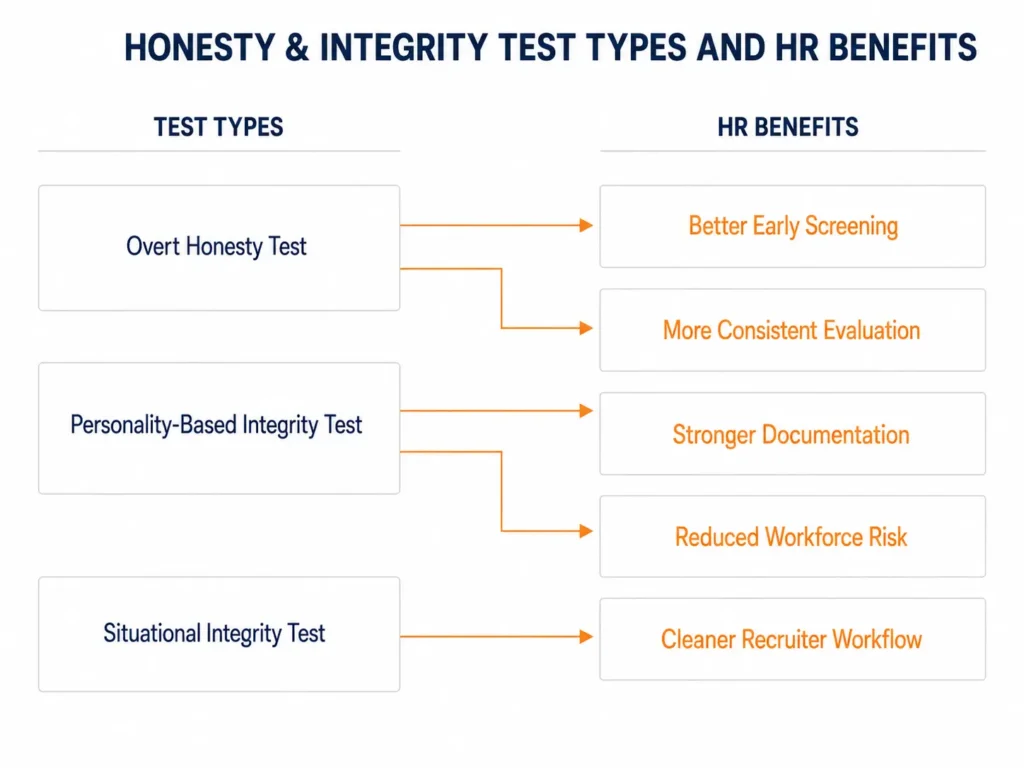
Most honesty and integrity tests fall into three broad categories: overt, personality-based, and situational. Some modern tools blend more than one method.
Each type gives HR a different kind of signal.
1. Overt Honesty Tests
Overt honesty tests ask direct questions about attitudes, admissions, and beliefs related to honesty, theft, rule-following, drug use, absenteeism, safety, or workplace conduct.
Examples of question areas may include:
- attitudes toward theft,
- views on workplace rules,
- past behavior admissions,
- comfort with policy violations,
- attendance and reliability patterns,
- reactions to dishonest coworker behavior.
The advantage of overt questions is clarity. The candidate understands what the employer is asking about, and the content is easier to connect to workplace risk.
The limitation is that some candidates may try to answer in the most socially desirable way.
For HR, overt tests can be especially useful in high-volume or frontline roles where the business needs a fast, practical risk screen before interviews or placement.
2. Personality-Based Integrity Tests
Personality-based integrity tests are less direct. They usually evaluate traits related to conscientiousness, dependability, impulse control, rule orientation, emotional stability, accountability, or attitudes toward authority and responsibility.
These tests do not always ask candidates directly whether they would steal, lie, or break rules. Instead, they look for patterns that may be associated with counterproductive workplace behavior.
The advantage is that personality-based measures can be harder to game because the purpose of each question may not be obvious.
The limitation is interpretation. If the report is too complex, recruiters may not know how to use the result.
Personality-based integrity tests are usually better when HR has a clear interpretation model, trained users, and a defined role context.
3. Situational or Scenario-Based Integrity Tests
Situational tests present candidates with realistic workplace scenarios and ask how they would respond.
A scenario may involve:
- finding a coworker violating a rule,
- being asked to ignore a safety procedure,
- handling a customer issue honestly,
- reporting a mistake,
- deciding whether to take a shortcut under pressure,
- responding when a supervisor is not present.
The advantage is business relevance. HR and hiring managers can often understand these results more easily because the questions resemble real workplace decisions.
The limitation is that scenarios need to match the role. A scenario designed for a retail role may not fit transportation, construction, healthcare support, or manufacturing.
Situational tests work best when the employer can connect the scenario to actual job expectations.
Overt vs. Personality-Based vs. Situational: Which One Should HR Use?
There is no single best format for every employer.
The right format depends on the role, hiring volume, risk level, candidate experience, and how recruiters will use the result.
| Test type | Best fit | Watch-out |
| Overt honesty test | Fast, clear screening for frontline or high-volume roles | Candidates may try to answer favorably |
| Personality-based integrity test | Broader behavioral risk and dependability signals | Requires careful interpretation |
| Situational integrity test | Role-specific judgment and policy scenarios | Must reflect realistic job situations |
| Blended model | Employers that want a clearer risk signal across multiple dimensions | HR still needs simple result bands and rules |
Many HR teams prefer blended approaches because honesty, dependability, accountability, and workplace conduct rarely show up in only one type of question.
For a deeper comparison of overt and personality-based approaches, read Overt vs. Personality-Based Honesty Test.
What Honesty and Integrity Tests Can Help Predict
Honesty and integrity tests are usually used to evaluate risk areas that are difficult to see in interviews alone.
They may support HR decisions related to:
| Risk area | Why it matters |
| Theft or misuse of property | Relevant for roles with cash, tools, inventory, or customer property |
| Attendance and absenteeism | Critical for hourly, shift-based, and field roles |
| Safety shortcuts | Important in construction, logistics, manufacturing, and transportation |
| Policy violations | Relevant where rules protect customers, coworkers, or operations |
| Workplace conduct | Helps reduce preventable conflict or disciplinary issues |
| Dependability | Supports roles that require consistency from day one |
| Accountability | Helps identify candidates who may own mistakes and follow standards |
The test should not be sold internally as a crystal ball. It should be framed as one structured data point that helps HR identify risk earlier and apply standards more consistently.
For candidate selection methodology, see Honesty and Integrity Tests for Candidate Selection.
What Honesty and Integrity Tests Should Not Be Expected to Do
A useful HR tool becomes risky when the company expects too much from it.
Honesty and integrity tests should not be used to:
- replace interviews,
- replace background checks where required,
- predict every future workplace issue,
- diagnose personality or mental health conditions,
- judge a candidate’s character in a broad moral sense,
- serve as the only basis for every hiring decision,
- compensate for poor management, weak onboarding, or unsafe workplace practices.
For example, an integrity test can help identify risk signals related to rule-following and accountability. It cannot fix a work environment where supervisors routinely reward shortcuts.
It can help recruiters prioritize candidates more consistently. It cannot replace a structured hiring process.
This distinction matters because it keeps the tool in its proper role: useful, but not absolute.
Why HR Teams Use Honesty and Integrity Tests

HR teams use honesty and integrity tests because many hiring problems are expensive only after the hire is made.
By the time a reliability issue appears, the company may already have paid for job ads, recruiter time, interviews, onboarding, training, uniforms, equipment, or client placement.
The business benefits usually fall into five areas.
1. Better Early Screening
The assessment helps recruiters identify risk before interview time is heavily invested.
This is especially useful in high-volume hiring, where recruiters may be moving through many candidates quickly and need a consistent signal before scheduling live conversations.
2. More Consistent Candidate Evaluation
Without a structured tool, one recruiter may focus on attendance concerns while another focuses on interview confidence. One hiring manager may overlook a red flag because the candidate was personable.
An honesty and integrity test gives the team a shared screening input.
3. Stronger Hiring Documentation
If the test is job-related, consistently applied, and tied to defined decision rules, it can help HR document how candidates were evaluated.
Documentation matters when multiple locations, recruiters, or managers are involved.
4. Reduced Workforce Risk
For roles where conduct, safety, attendance, theft, or reliability issues create operational cost, earlier risk screening can help HR avoid preventable problems.
This is especially relevant in staffing, transportation, construction, logistics, healthcare support, retail, hospitality, manufacturing, and warehouse environments.
5. Cleaner Recruiter Workflows
The best honesty and integrity tests give recruiters a simple output such as Qualified, Review, or Not Qualified.
That kind of output is easier to use than a long report with no next step.
For workflow design, read How to Use Honesty and Integrity Tests in Hiring.
Legal and Compliance Considerations for HR
Honesty and integrity tests can be useful, but HR should treat them as employment selection tools.
The EEOC explains that employers use tests and selection procedures to screen applicants, and that these tools can be effective when used properly. The same guidance warns that tests can create legal issues if they are used in a discriminatory way or disproportionately exclude protected groups without proper justification. EEOC employment tests and selection procedures.
The Uniform Guidelines on Employee Selection Procedures apply to tests and other selection procedures used as the basis for employment decisions, including hiring, promotion, referral, retention, and related employment decisions. Uniform Guidelines on Employee Selection Procedures.
Before launch, HR should define:
| Area | What to document |
| Job relevance | Why the test is appropriate for the role |
| Timing | When candidates take the test |
| Consistency | Which candidates are tested under the same standard |
| Decision rules | How results affect next steps |
| Review process | What happens with borderline results |
| Overrides | When exceptions are allowed |
| Data access | Who can see results |
| Monitoring | How outcomes and adverse impact are reviewed |
This does not mean the process needs to be slow. It means the process needs to be clear.
How HR Should Explain the Test to Candidates
Candidate communication should be straightforward.
A good message explains what the test is, why it is part of the process, how long it takes, and what happens next.
Example:
“Please complete this short pre-employment assessment as the next step in your application. It helps us evaluate candidates consistently for this role and can be completed from any device.”
Avoid language that makes the assessment sound like a moral interrogation.
Do not say:
“This test decides if you are honest.”
“We use this to catch risky candidates.”
“You must prove your integrity before continuing.”
The candidate does not need a lecture. They need a clear next step.
Where IntegrityFirst Fits
IntegrityFirst is designed for employers that need a focused honesty, integrity, reliability, and workforce risk screen before too much time is invested in a candidate.
That makes it a strong fit for:
- staffing,
- construction,
- transportation,
- logistics,
- healthcare support,
- manufacturing,
- retail,
- hospitality,
- warehouse and field roles,
- high-volume hourly hiring.
IntegrityFirst is built for practical use in roles where reliability and conduct matter from day one. Its public materials describe an assessment that takes under 8 minutes, delivers instant results, and integrates with ATS, VMS, staffing, or hiring platforms depending on the workflow. Integrity Testing for Staffing.
For employers evaluating this category, IntegrityFirst is not trying to be every assessment tool. Its value is narrower and more operational: help HR identify integrity and reliability risk before the process moves too far forward.
Common Mistakes HR Should Avoid
Treating the Test as a Character Judgment
The test should be presented as a job-related screening tool, not as a broad judgment of a person’s character.
Using the Same Test Logic for Every Role
Different jobs carry different risk. A single standard may not fit every role family.
Giving Recruiters a Report Without a Decision Rule
Recruiters need to know what to do with the result. A report without a workflow creates inconsistency.
Testing Too Late
If managers are already committed to a candidate, the result may be ignored or treated as an obstacle.
Ignoring Candidate Experience
A confusing invitation can reduce completion rates and create unnecessary questions.
Forgetting to Monitor Results
HR should review completion rate, pass-through rate, outcome data, overrides, and adverse impact over time.
FAQ
What is an honesty and integrity test definition and types for HR?
An honesty and integrity test definition and types for HR refers to a structured explanation of what these tests measure, how overt, personality-based, and situational formats differ, and how HR teams use them in hiring.
What does an honesty and integrity test measure?
It may measure honesty, dependability, accountability, rule-following, reliability, attitudes toward workplace conduct, and risk patterns related to counterproductive workplace behavior.
What are the main types of honesty and integrity tests?
The main types are overt honesty tests, personality-based integrity tests, and situational or scenario-based integrity tests. Some vendors use a blended model.
Are honesty and integrity tests the same as background checks?
No. A background check verifies historical information such as criminal records, employment history, or credentials, depending on the check. An honesty and integrity test evaluates current attitudes, traits, or behavioral patterns relevant to workplace risk.
Should HR use honesty and integrity tests for every role?
Not necessarily. HR should use them where honesty, reliability, conduct, safety, attendance, theft risk, or policy adherence are job-relevant.
Are honesty and integrity tests legal?
They can be used legally when they are job-related, consistently applied, properly documented, and monitored for fairness. HR should review EEOC guidance and the Uniform Guidelines on Employee Selection Procedures.
Final Takeaway
An honesty and integrity test is most useful when HR understands what it is designed to measure and where it belongs in the hiring process.
The definition matters because the test is not a background check, a personality quiz, or a replacement for judgment. The type matters because overt, personality-based, and situational tests give different signals. The workflow matters because even a strong test can fail if recruiters do not know how to use the result.
For employers that need a focused pre-interview screen, IntegrityFirst Tests helps evaluate honesty, accountability, reliability, and workforce risk before recruiters and managers invest more time. It is especially useful for high-volume and risk-sensitive environments where conduct, dependability, attendance, and safety have real business impact.
For companies that want that assessment connected to the broader hiring process, Discovered brings applicant tracking, workflows, assessments, candidate communication, scorecards, interviews, and automation into one platform.
IntegrityFirst gives HR the focused honesty and integrity signal.
Discovered gives HR the connected hiring system around it.
To reduce hiring risk with a focused integrity screen, schedule an IntegrityFirst demo.
To connect assessments with ATS workflows, scorecards, communication, interviews, and automation, book a Discovered demo.