Schedule a call!
Hiring decisions are bets, and the traditional way of placing them, an unstructured interview, a quick read of a resume, a reference call, is remarkably poor at predicting who will follow the rules once the offer is signed. Those methods are vulnerable to interviewer bias and to candidates who present well, which is exactly why they miss the behaviors that cost the most: theft, time fraud, safety shortcuts, and the broader category researchers call counterproductive work behavior.
That gap is the reason to look closely at the honesty and integrity assessment research and evidence rather than at vendor claims. This article summarizes what the science actually supports, and where it has been revised: how strongly these assessments predict workplace risk, what the latest re-analyses temper, what the evidence says about fairness, where the limits are, and what a measured rollout looked like in a real operation.
Where the Evidence Comes From
Modern integrity testing has a clear origin. Before 1988, employers leaned heavily on the pre-employment polygraph, with most of the millions of polygraphs administered each year used for applicant screening. The Employee Polygraph Protection Act ended most of that practice for private employers and pushed the field toward scientifically validated, written, and now digital instruments.
What separates these tools from a general personality test is focus. Rather than measuring broad traits like extroversion, a honesty and integrity assessment targets specific risk factors tied to theft, behavioral reliability, drug use, and rule-following. The US Office of Personnel Management recognizes these instruments as valid predictors of theft, absenteeism, and overall job performance, which is the baseline the rest of the evidence builds on.
What the Research Shows About Predictive Validity
The headline finding across decades of study is that integrity assessments predict counterproductive work behavior more reliably than most tools HR already uses, and that their value grows when they are paired with a cognitive-ability measure.
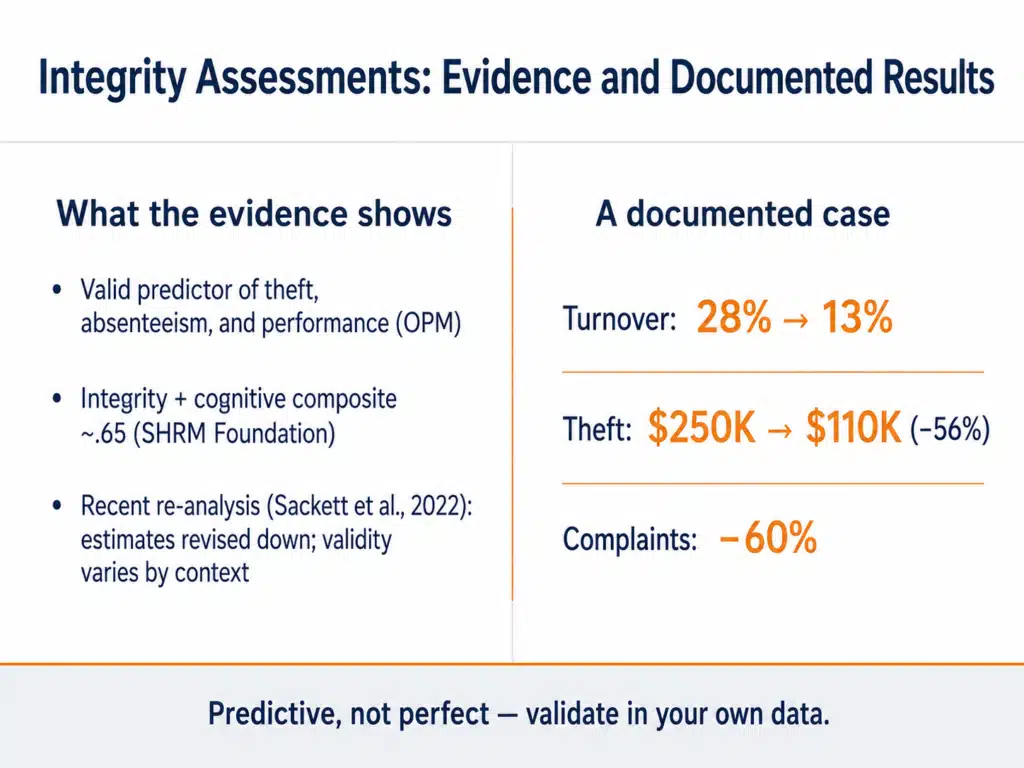
The foundational estimates come from Schmidt and Hunter’s landmark 1998 review in Psychological Bulletin, which placed integrity tests among the selection methods that add the most incremental validity on top of cognitive ability. The SHRM Foundation’s Selection Assessment Methods translates that into a practical figure: the integrity-plus-cognitive composite reaches a validity near .65, which it notes explains roughly 42 percent of the variance in job performance.
Recent scholarship adds an important caution rather than a contradiction. A 2022 re-analysis by Sackett, Zhang, Berry, and Lievens in the Journal of Applied Psychology found that decades of meta-analyses had systematically over-corrected for range restriction, which inflated many validity estimates, integrity tests included. Their revised numbers are more modest, and they show that integrity-test validity varies considerably from setting to setting.
The takeaway is not that integrity tests stopped working; they remain among the more useful and fairer predictors available. The lesson is that you should treat any single headline coefficient with caution, expect validity to depend on the format, the role, and how the outcome is measured, and validate the tool against your own results rather than trust a vendor’s best-case number.
The evidence also distinguishes between formats. Overt tests, which ask directly about attitudes toward theft and past behavior, carry high face validity but are markedly more susceptible to faking, because a motivated candidate can often guess the approved answer. Personality-based measures infer risk from traits like conscientiousness and emotional stability, and they resist faking far better, though they read risk indirectly. Our comparison of overt and personality-based honesty tests breaks down where each format fits, and the combined approach is covered in our look at a honesty and integrity assessment for smarter hiring.
The Evidence on Fairness and Bias
A fair amount of the research attention goes to whether these tools are equitable, and the findings are favorable. Integrity assessments generally show small average score differences across gender and across racial and ethnic groups, per OPM, which means adding one alongside a higher-disparity measure can actually lower a process’s overall adverse impact rather than raise it.
That matters more than it first appears, because the alternative, subjective judgment, carries its own quiet bias. In their study Bias in Context, published in the Journal of Management (Hardy et al., 2022), researchers found that even small subgroup biases in evaluator judgment (around d = −0.30) compound through a hiring funnel into practically significant discrimination and productivity loss. A structured, validated assessment narrows the room for that kind of drift, because it applies the same scored criteria to every candidate.
None of this removes the employer’s obligations, of course. The law firm Ogletree Deakins, summarizing an EEOC discussion of integrity testing, notes that problems arise when items reveal protected-class or medical information, or when results are adjusted to screen out protected groups. In other words, the evidence supports the tool, but fairness still depends on how you build and monitor it. The full compliance picture is in our guide to honesty test legal compliance in hiring.
Honesty and Integrity Assessment Research and Evidence in Practice: A Case Study

Aggregate validity is persuasive, but HR leaders act on outcomes they can see, so consider a documented multi-site frontline operation. Before screening, the business carried an involuntary turnover rate near 28%, roughly $250,000 in annual theft-related costs, and a volume of customer complaints that was damaging its reputation.
After introducing a structured honesty and integrity assessment into the hiring process, the measured results over the following period were substantial:
| Metric | Before | After | Change |
| Involuntary turnover | ~28% | ~13% | About a 53% relative reduction |
| Theft-related annual cost | $250,000 | $110,000 | 56% reduction (~$140,000 recovered) |
| Customer complaints | Baseline | Post-rollout | 60% reduction |
The same body of evidence helps explain why the gains clustered together. The trait pattern that predicts respect for organizational property, manifesting as less theft, overlaps with the pattern that predicts respect for people and process, which is why a single screen moved theft, complaints, and turnover at once. Screened cohorts in related research also generated meaningfully fewer safety incidents than unscreened hires.
A case study is illustrative, not proof on its own, which is exactly why it belongs next to the aggregate research rather than in place of it. One operation’s results can be shaped by everything from a new manager to a tighter labor market, so the honest reading is that the screen plausibly contributed to the change, in a direction the wider evidence predicts. For the mechanism behind the retention effect, see our analysis of how honesty tests reduce employee turnover, and for the broader business case, the ROI of honesty tests in hiring.
What the Evidence Does Not Promise
Reading the research honestly means naming its limits. These assessments are predictive, not perfect. They are stronger at forecasting misconduct than at predicting voluntary turnover, so they are not a retention cure on their own. Overt formats can be coached, which is why response-distortion controls and format choice matter. And, as the 2022 re-analysis underlined, validity varies enough between settings that last year’s numbers in another industry are no guarantee of this year’s in yours.
The consistent recommendation across the literature is therefore the same: use the result as one input, not an automatic screen-out. The evidence is strongest when an integrity assessment sits alongside a structured interview and, where appropriate, a cognitive measure, with a low score triggering a documented follow-up rather than an immediate rejection. The deeper data-driven view is in our breakdown of a data-driven honesty and integrity test for selection, and the wider research base in our honesty tests for employment facts and research.
Frequently Asked Questions
Are honesty and integrity assessments scientifically valid?
Yes. Decades of research, including federal recognition by OPM and foundational reviews in industrial-organizational psychology, support their validity for predicting counterproductive work behavior and overall job performance, and validity rises when they are paired with a cognitive-ability measure.
How strong is the evidence, given recent re-analyses?
A 2022 re-analysis (Sackett et al., Journal of Applied Psychology) corrected a long-standing statistical issue and lowered many validity estimates across the field, integrity tests included. They remain useful and comparatively fair predictors; the practical change is that you should expect validity to vary by context and confirm it in your own data rather than rely on a single published figure.
Do these assessments create adverse impact?
They tend to show small average score differences across protected groups, which often reduces a process’s overall adverse impact. You still monitor your own selection rates with the four-fifths comparison, and you keep test items clear of protected-class or medical information.
Can candidates fake the results?
Some try, especially on overt formats, where the intent is obvious. Personality-based measures resist faking better, and combined assessments add consistency and response-distortion checks. Treat any single score as one input rather than a verdict.
Should an integrity score ever be the only reason to reject a candidate?
No. The research consistently recommends using the score as one signal within a structured process. A low band is best treated as a prompt for a documented follow-up, alongside a structured interview and references, not as an automatic, standalone screen-out.
Turn the Evidence Into a Hiring Advantage
The honesty and integrity assessment research and evidence point in one direction: used well, these tools predict the behaviors that quietly drain a workforce, and they do it more fairly than the subjective methods they replace. IntegrityFirst Tests gives HR a validated, fast integrity assessment built for the pre-interview stage, so the evidence translates into fewer bad hires and measurable results. Schedule an IntegrityFirst demo to put the research to work on your highest-risk roles.
When you want that screen connected to the rest of hiring, applicant tracking, scorecards, interview scheduling, and automation, Discovered brings assessment and workflow into one system, so a result flows straight into the next step. IntegrityFirst supplies the evidence-based signal; Discovered connects it across the hiring process.