Schedule a call!
Trust is one of the most expensive hiring assumptions a company makes.
A candidate may interview well, give confident answers, and present a clean version of their work history. A hiring manager may feel comfortable moving forward because the conversation felt strong. A recruiter may be under pressure to fill the role and keep the process moving.
Then the real test starts after hire.
- Does the person show up consistently?
- Do they follow workplace rules when no one is watching?
- Do they handle customer property, inventory, tools, money, or sensitive information responsibly?
- Do they admit mistakes?
- Do they take shortcuts when speed matters more than judgment?
- Do they create trust with managers, coworkers, clients, and customers?
That is why integrity and honesty in hiring to assess trust should not be treated as a soft concept. Trust can be evaluated more deliberately when HR combines structured assessment, interview follow-up, reference patterns, role-risk criteria, and outcome measurement.
The goal is not to claim that any assessment can “prove” trust. It cannot. The goal is to help HR stop relying only on instinct when trust is one of the most important requirements of the role.
For a broader methodology on honesty and integrity assessment, read Honesty and Integrity Assessment for Smarter Hiring. This article focuses on trust as a hiring outcome HR can define, evaluate, and track.
Why Trust Should Be Treated as a Hiring Requirement
Most job descriptions include technical requirements, availability, experience, certifications, or physical requirements. Far fewer define what trust means in the role.
That is a problem.
Trust looks different depending on the job.
For a warehouse associate, trust may mean following safety procedures, reporting errors, and handling inventory responsibly. For a caregiver, it may mean reliability, honesty with documentation, and responsible behavior with vulnerable clients. For a driver, it may mean judgment, schedule dependability, and policy adherence. For a retail employee, it may include cash handling, customer interaction, and theft prevention.
A generic statement like “must be trustworthy” is not enough.
HR should translate trust into observable role expectations.
| Role context | What trust may include |
| Cash or inventory access | Honest handling of money, tools, supplies, or merchandise |
| Safety-sensitive work | Rule-following, judgment, and willingness to report risks |
| Client-facing roles | Professional conduct, reliability, and accountability |
| Unsupervised work | Dependability when managers are not present |
| Healthcare support | Care standards, documentation accuracy, and attendance |
| Staffing or temporary placement | Consistency, client trust, and low placement risk |
| Field or construction roles | Safety discipline, schedule reliability, and policy adherence |
Once trust is defined by role, HR can evaluate it more consistently.
For broader test definitions and formats, connect this guide to Honesty and Integrity Test Definition and Types for HR.
What Honesty and Integrity Assessments Can Add
Interviews are important, but they are not enough for evaluating trust.
Candidates know how to prepare for common interview questions. Managers may overvalue confidence. Recruiters may not have enough time to probe every reliability or conduct concern. References may be limited by policy or timing.
A structured honesty and integrity assessment gives HR an earlier signal.
The U.S. Office of Personnel Management describes integrity and honesty tests as assessments designed to evaluate whether an applicant is likely to be honest, trustworthy, and dependable. OPM also links low integrity with counterproductive workplace behaviors such as theft, absenteeism, sabotage, disciplinary problems, and violence.
For HR teams, that is useful because trust in hiring is not only about whether a person says they value honesty. It is about whether their responses show patterns related to reliability, accountability, rule-following, and workplace conduct.
An assessment can help HR identify:
- candidates who show strong alignment with role expectations,
- candidates who may need structured review,
- candidates whose responses suggest elevated workplace risk,
- areas that should be explored through approved interview questions,
- patterns that should be measured after hire.
For HR function-wide implementation, use Honesty and Integrity Assessment for HR Teams.
Trust Should Not Depend on One Signal
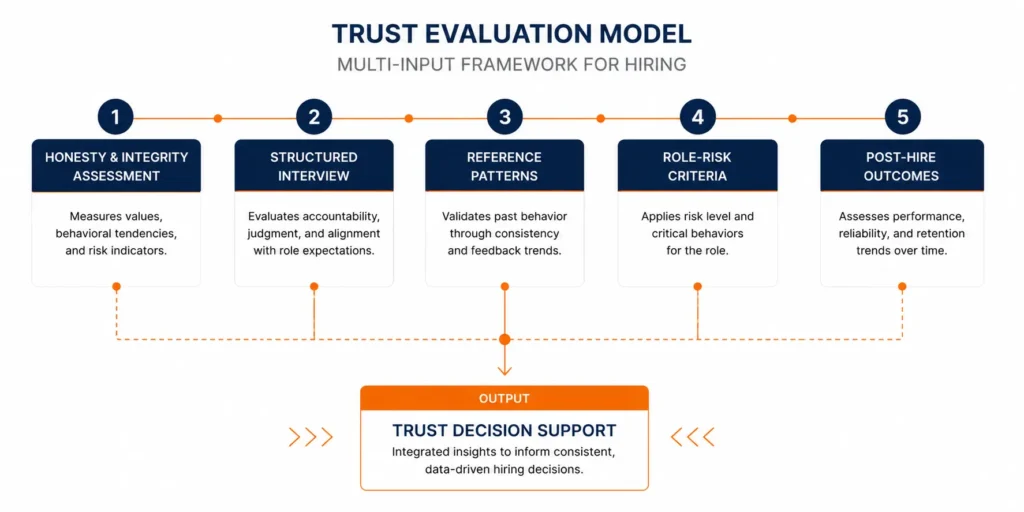
A hiring team should not reduce trust to one score.
A stronger model combines several inputs:
| Input | What it contributes |
| Honesty and integrity assessment | Early signal on reliability, accountability, rule-following, and conduct risk |
| Structured interview | Context, examples, judgment, and communication |
| Reference patterns | Past behavior and work history context |
| Role-risk criteria | Clear definition of what trust requires in the job |
| Review bands | Consistent decision path for recruiters |
| Post-hire outcomes | Data to confirm whether the process is working |
This is the difference between saying “we trust this candidate” and being able to explain why the candidate should move forward.
For roles where trust is especially important, the assessment should usually happen after minimum qualifications and before major interview time. That gives HR a useful signal before the hiring manager becomes attached to a candidate.
For workflow design, read How to Use Honesty and Integrity Tests in Hiring.
A Practical Trust Review Model
A useful trust evaluation process should not be complicated.
It should make the next step clear.
| Result | What it means | HR action |
| Qualified | No major trust, reliability, or integrity concerns identified | Continue the hiring process |
| Review | Some responses or patterns require a second look | Apply structured review criteria |
| Not qualified | Risk level does not meet the role standard | Follow approved disposition process |
| Incomplete | Candidate did not complete the assessment | Send reminder or close after deadline |
The “Review” category matters because trust is not always binary.
A candidate may show one area of concern that deserves context. Another may have responses that require escalation before the interview. A third may need a structured follow-up question rather than immediate disposition.
The review process should define:
- who owns the review,
- what information may be considered,
- which follow-up questions are approved,
- how the decision is documented,
- when the candidate may continue.
For candidate selection methodology, connect this article with Honesty and Integrity Tests for Candidate Selection.
Interview Questions That Help Assess Trust

Assessment results become more useful when they improve the next conversation.
If a candidate moves forward after an honesty and integrity assessment, recruiters and hiring managers can use structured questions to better understand judgment, accountability, and conduct.
Examples:
- “Tell me about a time you made a mistake at work. What did you do next?”
- “Describe a situation where you had to follow a policy you did not fully agree with.”
- “Have you ever seen a coworker take a shortcut that created risk? How did you respond?”
- “Tell me about a time you had access to money, inventory, tools, or customer property. What controls or expectations were in place?”
- “Describe a situation where a manager was not present and you had to decide the right thing to do.”
The goal is not to trap the candidate. The goal is to understand how they handle real workplace situations where trust matters.
Questions should be used consistently and tied to job requirements. A retail cash-handling role may need different follow-up than a construction, healthcare support, logistics, or field service role.
References Can Support the Trust Picture
References are not perfect. Many employers limit what they will share, and some references are chosen carefully by the candidate.
Still, references can support a broader trust evaluation when used with structure.
Instead of asking vague questions like “Was this person trustworthy?”, use specific work-related areas:
- reliability,
- attendance,
- accountability,
- policy adherence,
- quality of communication,
- response to mistakes,
- ability to work with limited supervision,
- consistency under pressure.
A structured reference question might sound like:
“Can you describe how this person handled accountability when something went wrong at work?”
or:
“How dependable was this person with schedule expectations, handoffs, or assigned responsibilities?”
The value comes from pattern recognition. If the assessment, interview, and references all point in the same direction, HR has a stronger basis for the decision.
For program deployment, connect this guide to Honesty Integrity Tests for Hiring Programs.
Measuring Trust After Hire
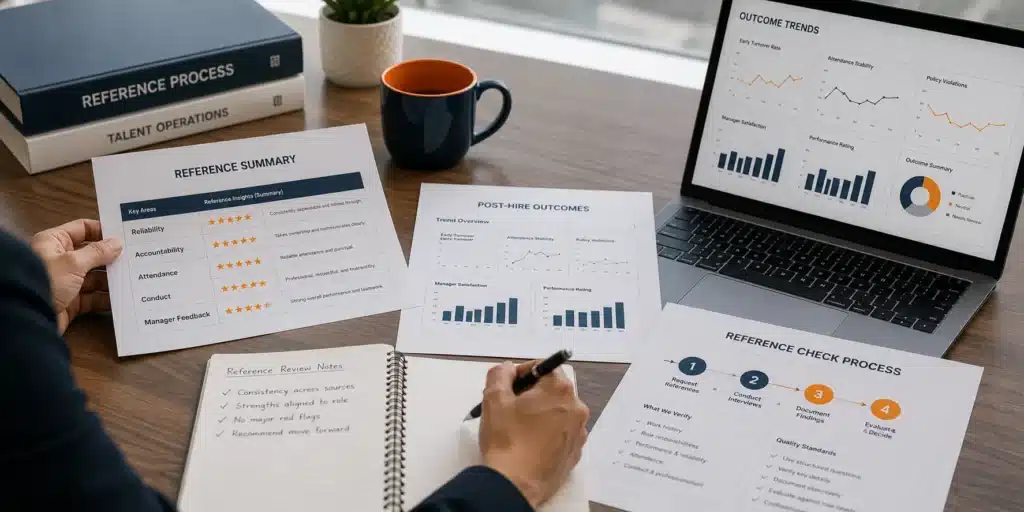
Trust in hiring should eventually connect to outcomes.
If HR says trust matters, the program should track whether screening improves the indicators that trust is supposed to affect.
Useful metrics include:
| Metric | Why it matters |
| Early turnover | Shows whether selected candidates stay long enough to justify hiring investment |
| Absenteeism | Useful for roles where reliability is central |
| Claims or incidents | Relevant in safety-sensitive or field roles |
| Policy violations | Shows whether conduct issues are changing |
| Theft or shrinkage indicators | Relevant where inventory, cash, or property access matters |
| Customer or client complaints | Useful in service and placement roles |
| Manager trust rating | Can be measured through post-hire check-ins |
| Review-case outcomes | Shows whether “Review” decisions are working |
| Override frequency | Shows whether managers are bypassing the process |
| Adverse impact review | Supports fairness monitoring |
The point is not to turn trust into a single perfect number. The point is to stop treating it as invisible.
A strong HR program can compare pre-hire signals with post-hire outcomes and refine the workflow over time.
For a data-first approach to integrity testing, read Data-Driven Honesty and Integrity Test for Employee Selection.
Three Example Trust Outcomes HR Can Track
Use this section only with verified internal or client-approved data. The structure is useful because it shows how trust becomes measurable, but any numbers should be confirmed before publishing.
| Organization type | Trust problem before assessment | Assessment workflow | Outcome to measure |
| High-volume staffing firm | Client complaints, no-shows, and replacement hires | Integrity assessment before recruiter submission | Fewer client escalations, lower no-show rate, better placement reliability |
| Retail or hospitality employer | Shrinkage, attendance issues, and early turnover | Honesty and integrity screen after minimum qualifications | Lower early turnover, fewer conduct issues, reduced loss indicators |
| Construction or logistics employer | Safety shortcuts, claims, and attendance concerns | Assessment plus structured review before interview | Lower incident trends, better attendance, fewer claim-related disruptions |
If the original blog has approved case-study data, this is where the three-organization case table should live. The table should avoid exaggerated claims and focus on practical before/after indicators.
Compliance and Fairness Should Stay in the Process
Trust screening should be consistent, job-related, and documented.
The EEOC explains that employment tests and selection procedures can help employers evaluate applicants, but they can create legal issues if used in a discriminatory way or if they disproportionately exclude protected groups without proper justification.
The Uniform Guidelines on Employee Selection Procedures apply to tests and other selection procedures used as the basis for employment decisions.
For HR, that means the process should define:
- which roles require trust screening,
- why trust is job-related for those roles,
- when the assessment is used,
- how results affect candidate movement,
- how review cases are handled,
- how overrides are documented,
- how outcomes and adverse impact are monitored.
The assessment should not become an informal shortcut. It should make the process easier to explain.
What HR Should Avoid
Treating Trust as a Feeling
A hiring manager may “trust” a candidate because the interview felt good. That is not enough. Trust should be tied to job-relevant evidence.
Using One Assessment Result in Isolation
Assessment data is useful, but it should be combined with qualifications, structured interviews, references, and role requirements.
Asking Unstructured Interview Questions
If managers improvise trust questions, they may create inconsistency. Use approved questions tied to job expectations.
Ignoring Role Context
Trust looks different across roles. A cashier, driver, caregiver, field technician, and supervisor may require different risk criteria.
Testing Too Late
If the assessment happens after several interviews, trust signals may be discounted because the hiring team already wants the candidate.
Failing to Measure Outcomes
If HR does not track turnover, absenteeism, incidents, complaints, or review-case quality, it cannot know whether the process is improving.
FAQ
What does integrity and honesty in hiring to assess trust mean?
Integrity and honesty in hiring to assess trust means using structured hiring inputs, such as assessments, interviews, references, and role-risk criteria, to evaluate whether candidates are likely to be reliable, accountable, truthful, and aligned with workplace standards.
Can trust be measured in hiring?
Trust cannot be measured perfectly, but HR can evaluate job-related trust signals. These may include honesty, reliability, accountability, policy adherence, attendance patterns, conduct risk, and follow-through after hire.
Should employers rely only on honesty and integrity assessments?
No. Assessments should support hiring decisions, not replace interviews, references, qualifications, or manager judgment. The strongest process combines multiple job-related inputs.
Where should trust screening happen in the hiring process?
For high-volume or risk-sensitive roles, trust screening usually works best after minimum qualifications and before major interview time. This gives HR a useful signal before managers become invested in a candidate.
What roles benefit most from trust screening?
Trust screening is especially useful in roles involving cash, inventory, tools, customer property, safety exposure, client contact, unsupervised work, healthcare support, field service, logistics, staffing, construction, retail, hospitality, and manufacturing.
How should HR track trust after hiring?
HR can track early turnover, absenteeism, incidents, policy violations, customer complaints, claims, manager feedback, review-case outcomes, and adverse impact indicators.
Final Takeaway
Trust should not enter the hiring process only as a manager’s impression after an interview.
For roles where reliability, honesty, accountability, safety, property, customer trust, or client relationships matter, HR needs a more structured way to evaluate trust before the hiring decision is already moving forward.
That is the value of using integrity and honesty in hiring to assess trust. The assessment gives HR an earlier signal. Structured interviews and references add context. Review bands create consistency. Outcome tracking shows whether the process is working.
For employers that need a focused pre-interview screen, IntegrityFirst Tests helps evaluate honesty, accountability, reliability, and workforce risk before recruiters and managers invest more time. It is especially useful for high-volume and risk-sensitive hiring environments where conduct, dependability, attendance, safety, claims, trust, and turnover create real business cost.
For companies that want that assessment connected to the broader hiring workflow, Discovered brings applicant tracking, workflows, assessments, candidate communication, scorecards, interviews, and automation into one platform.
IntegrityFirst gives HR the focused honesty and integrity signal.
Discovered gives HR the connected hiring system around it.
To reduce hiring risk with a focused integrity screen, schedule an IntegrityFirst demo.
To connect assessments with ATS workflows, scorecards, communication, interviews, and automation, book a Discovered demo.