Schedule a call!
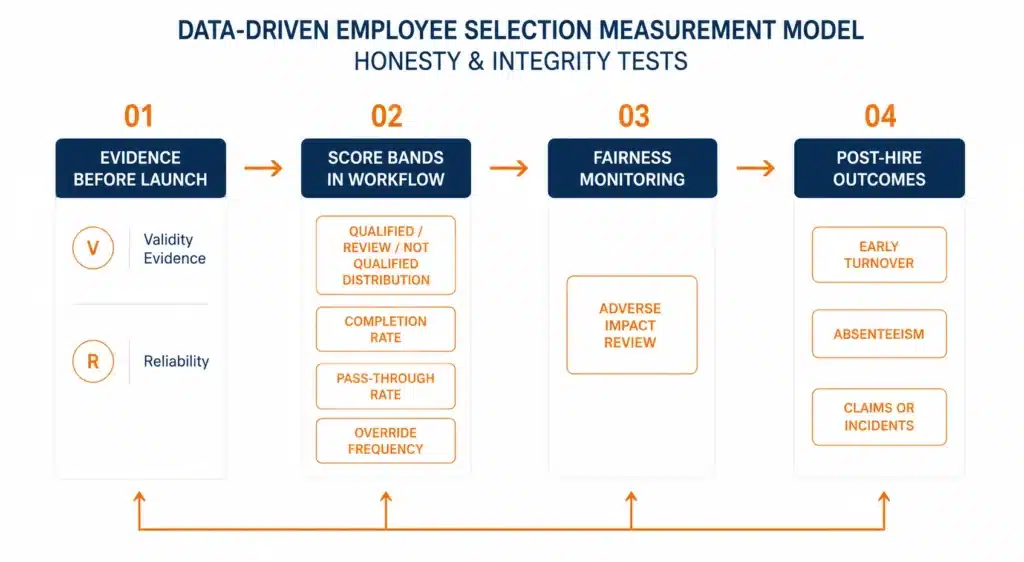
A test score does not mean much on its own. What matters is whether the score helps HR make a better employee selection decision, whether recruiters can apply it consistently, and whether the organization can measure what happens after the decision is made.
That is the role of a data-driven honesty and integrity test for employee selection.
It is not enough to say that a test is “validated” or “science-backed.” HR needs to understand what the test is designed to predict, how reliable the result is, how it fits into the hiring workflow, and which outcomes should be reviewed after launch.
For some organizations, the goal is reducing early turnover. For others, it is lowering preventable claims, improving attendance, reducing theft exposure, or creating a more consistent candidate review process across locations.
The assessment is only useful if the data connects to those decisions.
For a practical selection framework, read Honesty and Integrity Tests for Candidate Selection. This article focuses on the evidence, metrics, and data discipline HR should apply before scaling an integrity testing program.
What “Data-Driven” Should Mean in Employee Selection
In HR, “data-driven” should not mean adding more dashboards.
It should mean using the right evidence at the right point in the selection process.
For honesty and integrity testing, that means HR should be able to answer five questions:
| Data question | Why it matters |
| What does the test measure? | Keeps the assessment tied to job-relevant risk |
| What outcome is it expected to improve? | Connects the test to business value |
| How reliable are the results? | Shows whether the tool produces stable measurement |
| How should scores affect decisions? | Prevents recruiter-by-recruiter interpretation |
| What should HR monitor after launch? | Helps identify whether the process is working fairly and effectively |
The U.S. Office of Personnel Management describes integrity and honesty tests as assessments used to evaluate whether an applicant is likely to be honest, trustworthy, and dependable. OPM also connects low integrity with counterproductive workplace behaviors such as theft, absenteeism, sabotage, disciplinary problems, and violence.
That definition gives HR a practical starting point: the test should help evaluate workplace risk that matters to the role, not produce a broad moral judgment.
For foundational test definitions and formats, use Honesty and Integrity Test Definition and Types for HR.
The Evidence HR Should Ask Vendors to Explain
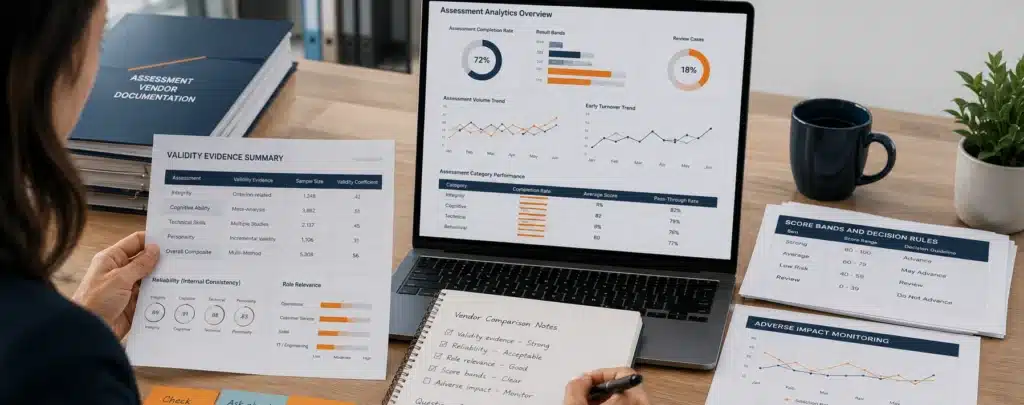
A vendor should be able to explain the evidence behind the test in plain language.
HR should ask for more than a sales claim. The vendor should be able to discuss validity, reliability, job relevance, sample size, score interpretation, adverse impact monitoring, and recommended use.
The conversation should sound like this:
| Evidence area | What HR should ask |
| Construct | What does the test measure: honesty, reliability, dependability, policy adherence, workplace risk, or something else? |
| Criterion validity | What outcomes has the test been linked to? |
| Reliability | How consistent are results across administrations or item sets? |
| Role relevance | Which job families are the strongest fit? |
| Score bands | How should Qualified, Review, and Not Qualified be interpreted? |
| False positives | How does the vendor reduce the risk of excluding candidates who may have performed well? |
| False negatives | How does the vendor handle candidates who pass but still create post-hire issues? |
| Adverse impact | What monitoring guidance is available? |
| Implementation data | What KPIs should HR track after launch? |
This type of evidence does not need to turn recruiters into industrial psychologists. It gives HR a way to judge whether the test is being used responsibly.
Validity: What the Test Is Actually Predicting
Validity is about whether the test supports the decision it is being used to make.
A data-driven honesty and integrity test should be tied to relevant outcomes such as:
- counterproductive workplace behavior,
- absenteeism,
- disciplinary issues,
- theft or policy violations,
- safety shortcuts,
- early turnover,
- reliability,
- overall workplace conduct.
Research on integrity testing has generally focused on whether these tools predict counterproductive work behavior and job performance. Some industry and research summaries cite corrected validity estimates around .32 for counterproductive work behavior and .18 for job performance in more conservative analyses, while older meta-analytic work reported stronger operational validity estimates depending on outcome, sample, and correction method.
HR should treat those numbers carefully. The point is not to promise that a test will predict every future issue. The point is to understand that validity depends on the test, role, outcome, sample, and decision rule.
A test may be useful for identifying risk patterns, but it should still be used as one structured input in a selection process.
For decision-quality use cases, connect this guide to Honesty Integrity Test for Effective Hiring Decisions.
Reliability: Why Consistency Matters Before Scale
Reliability is about measurement consistency.
If a tool produces unstable results, HR cannot confidently use those results in employee selection. A reliable test should measure its target construct consistently enough to support repeatable decision-making.
Some integrity testing summaries cite reliability estimates around .83 for certain measures or test batteries, but HR should always ask vendors what reliability evidence applies to the specific assessment being used.
The key question is not “Is there a reliability number somewhere?”
The better questions are:
Does the reliability evidence apply to this test?
Was it studied with a relevant applicant or employee population?
How recent is the evidence?
Does the scoring model change over time?
How often is the assessment reviewed or updated?
For HR teams, reliability matters because inconsistent measurement creates inconsistent selection decisions.
False Positives and False Negatives
No assessment tool is perfect.
A false positive happens when a candidate is flagged as risky but may have become a good hire. A false negative happens when a candidate passes the test but later creates problems the assessment did not catch.
Both matter.
| Error type | What it means | HR risk |
| False positive | Candidate is screened out but may have performed well | Lost talent, fairness concerns, lower applicant flow |
| False negative | Candidate moves forward but later creates issues | Turnover, incidents, claims, conduct risk |
Some discussions of selection tools note that false-positive rates can vary widely depending on cutoff scores, base rates, role context, and how the tool is used. That is why HR should avoid treating any score as absolute.
The practical solution is not to abandon testing. It is to design better decision rules.
That means:
- use review bands,
- avoid unnecessary hard cutoffs,
- monitor pass-through rates,
- track overrides,
- compare results with post-hire outcomes,
- revisit thresholds when role conditions change.
For a more detailed selection process, read How to Use Honesty and Integrity Tests in Hiring.
Score Bands Make Data Usable
Recruiters do not need a complicated statistical report for every candidate.
They need a result they can use in a documented workflow.
A practical model uses score bands:
| Band | Meaning | Selection action |
| Qualified | Candidate meets the defined standard for the role | Continue to next step |
| Review | Result requires structured secondary review | Apply approved review process |
| Not qualified | Result does not meet the role standard | Follow approved disposition process |
| Incomplete | Candidate did not finish the test | Send reminder or close after deadline |
The “Review” band is where data discipline matters most.
If review decisions are handled casually, the organization loses consistency. HR should define who reviews the result, what evidence is considered, how the decision is documented, and when the candidate may continue.
This keeps the test from becoming either too rigid or too subjective.
Adverse Impact Monitoring
A test may be job-related and still need monitoring.
The EEOC explains that employment tests and selection procedures can be effective tools, but they can create legal issues if they are used in a discriminatory way or if they disproportionately exclude protected groups without proper justification. The Uniform Guidelines on Employee Selection Procedures also provide a framework for the proper use of tests and other selection procedures used in employment decisions.
For HR, adverse impact monitoring should be part of the operating model, not a last-minute audit.
Track:
| Monitoring area | What HR should review |
| Invitation rate | Are similarly situated candidates receiving the same test? |
| Completion rate | Are some groups dropping off at higher rates? |
| Pass-through rate | Are selection outcomes consistent with expectations? |
| Review rate | Are certain roles or locations producing too many review cases? |
| Override rate | Are recruiters or managers bypassing the standard process? |
| Hiring outcome | Are selected candidates performing better over time? |
| Adverse impact indicators | Are protected groups disproportionately excluded? |
If the tool shows adverse impact, HR should review job relevance, alternative procedures, scoring, decision rules, and whether the test is being used as intended.
What KPIs HR Should Track After Launch

The most important test data appears after candidates enter the workflow.
HR should monitor whether the assessment is improving process quality and workforce outcomes.
| KPI | What it tells HR |
| Assessment completion rate | Candidate experience and process clarity |
| Average time to completion | Whether the test creates friction |
| Qualified / Review / Not qualified distribution | Whether score bands are behaving as expected |
| Review-case resolution time | Whether secondary review is creating bottlenecks |
| Override frequency | Whether the process is trusted or being bypassed |
| Recruiter adoption | Whether teams use the data consistently |
| Time-to-interview | Whether screening is improving funnel efficiency |
| Early turnover | Whether selection quality is improving |
| Absenteeism | Whether reliability outcomes are changing |
| Claims or incidents | Whether workplace risk indicators are improving |
| Hiring manager acceptance | Whether shortlists are more useful |
| Adverse impact review | Whether the process remains fair and defensible |
A data-driven program should review these metrics on a regular cadence. Monthly may be useful during pilot. Quarterly may be more realistic once the workflow stabilizes.
How to Pilot a Data-Driven Test Program
A pilot should be treated like a business test, not just a software launch.
Choose one role family where the business problem is clear. For example, a logistics team may be struggling with early turnover, attendance issues, safety shortcuts, or claims. A staffing team may need faster placement decisions with better risk visibility.
Before launch, define:
- the role family,
- the hiring stage,
- the result bands,
- the review owner,
- baseline metrics,
- success criteria,
- reporting cadence.
During the pilot, do not wait for perfect data before making operational improvements. If candidates do not understand the test, fix the message. If recruiters bypass the test, fix the workflow. If review cases pile up, assign ownership.
A good pilot should answer whether the assessment improves selection decisions under real hiring pressure.
How to Read Data Without Overstating It
Data helps HR make better decisions, but only if the interpretation is disciplined.
Avoid these claims:
“This test eliminates bad hires.”
“This score proves the candidate is honest.”
“This result predicts exactly what the person will do.”
“This tool removes the need for manager judgment.”
Better language:
“The assessment identifies risk signals tied to honesty, reliability, and workplace conduct.”
“The result should be used with structured interviews and other job-relevant selection inputs.”
“Outcome data should be reviewed after implementation.”
“Decision rules should be documented and applied consistently.”
That language is more credible and more defensible.
Where IntegrityFirst Fits in a Data-Driven Selection Program
IntegrityFirst is a strong fit when HR needs an early, practical read on honesty, accountability, reliability, and workforce risk.
IntegrityFirst is especially relevant for high-volume and risk-sensitive hiring environments, including staffing, construction, logistics, manufacturing, healthcare support, retail, hospitality, warehouse, field, and transportation roles.
IntegrityFirst’s public materials state that the assessment takes under 8 minutes, delivers instant results, and integrates with ATS, VMS, or staffing platforms for high-volume placement workflows. It also communicates outcomes such as lower workers’ compensation costs, fewer claims, lower claim severity, and reduced turnover in its staffing use case materials.
For HR teams, the advantage is not just a test result. It is the ability to bring a focused integrity signal into the process before too much time is spent on interviews or placement.
Where Discovered Fits
Discovered is the broader hiring platform around the assessment.
For companies that want assessment data connected to recruiter workflows, candidate communication, scorecards, interviews, and automation, Discovered provides the larger hiring ecosystem.
Discovered’s ATS content describes applicant tracking that helps teams organize candidates, automate workflows, and make faster hiring decisions. Its broader platform includes hiring workflows, candidate engagement, interview scheduling, and assessment-related automation.
That distinction matters.
Use IntegrityFirst when the immediate need is a focused honesty and integrity screen.
Use Discovered when the organization wants assessment data connected to the rest of the hiring workflow.
FAQ
What is a data-driven honesty and integrity test for employee selection?
A data-driven honesty and integrity test for employee selection is a structured pre-employment assessment used with validity evidence, reliability checks, score bands, review rules, and outcome tracking to support consistent hiring decisions.
What data should HR ask for before using an integrity test?
HR should ask vendors for evidence on what the test measures, reliability, validity, role relevance, recommended use, score interpretation, adverse impact monitoring, and implementation KPIs.
What outcomes can honesty and integrity tests support?
They may support decisions related to counterproductive workplace behavior, absenteeism, theft risk, policy violations, safety shortcuts, dependability, workplace conduct, and early turnover.
Should HR use hard cutoffs?
Not always. Hard cutoffs may be appropriate in some workflows, but many employers benefit from a review band that allows structured secondary review before final disposition.
How should adverse impact be monitored?
HR should review invitation rates, completion rates, pass-through rates, review rates, override rates, hiring outcomes, and selection patterns across protected groups where appropriate.
Is a test score enough to make an employee selection decision?
A test score should usually be one structured input in the selection process. HR should combine it with minimum qualifications, structured interviews, role requirements, and documented decision rules.
Final Takeaway
A data-driven integrity testing program is not about collecting more candidate data. It is about using the right data in the right decision.
A data-driven honesty and integrity test for employee selection should help HR understand whether the assessment is reliable, job-related, useful to recruiters, fair in practice, and connected to the outcomes the business actually cares about.
For employers that need a focused pre-interview screen, IntegrityFirst Tests helps evaluate honesty, accountability, reliability, and workforce risk before recruiters and managers invest more time. It is built for practical use in high-volume and risk-sensitive hiring workflows, especially where turnover, claims, absenteeism, conduct, safety, or trust issues create real cost.
For companies that want that assessment connected to the broader hiring process, Discovered brings applicant tracking, workflows, assessments, candidate communication, scorecards, interviews, and automation into one platform.
IntegrityFirst gives HR the focused honesty and integrity signal.
Discovered gives HR the connected hiring system around it.
To reduce hiring risk with a focused integrity screen, schedule an IntegrityFirst demo.
To connect assessments with ATS workflows, scorecards, communication, interviews, and automation, book a Discovered demo.