Schedule a call!
Integrity assessments for smarter hiring decisions give HR professionals a validated, structured method for evaluating candidates on the behavioral dimensions that predict real-world performance. Where conventional screening surfaces work history and stated references, structured integrity assessments measure responsibility, rule compliance, and ethical judgment—the exact traits linked to counterproductive work behavior, absenteeism, and voluntary turnover.
For organizations managing persistent mis-hire costs or filling roles with elevated integrity risk, this distinction directly affects decision quality and reduces the cost of poor hiring outcomes.
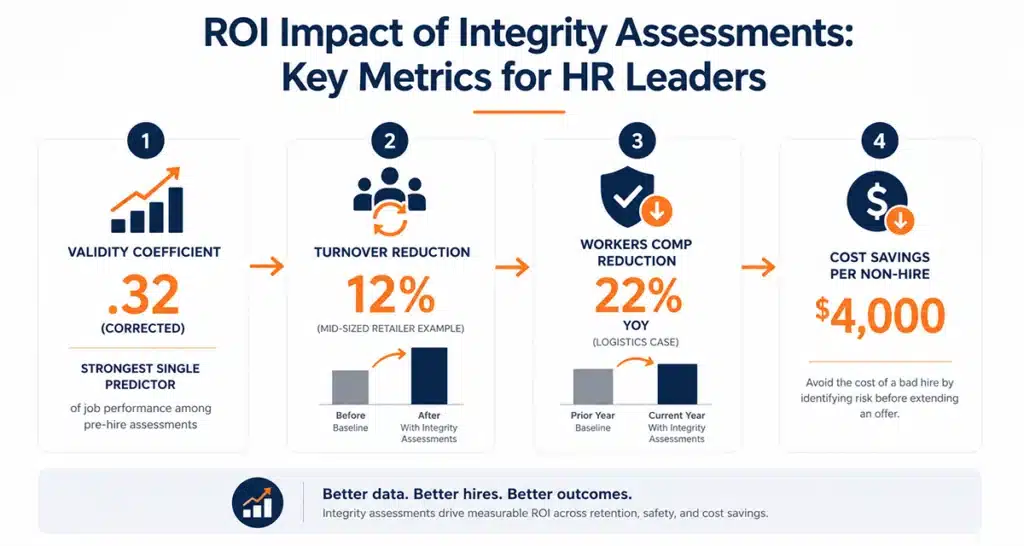
The research basis for this approach is specific and well-established. A meta-analysis of 104 studies found that integrity test scores produce a corrected validity of .32 for counterproductive work behavior—placing these assessments among the strongest single predictors available at the pre-offer stage. This predictive strength holds across both overt and personality-based formats and across role types.
The sections below explain how to evaluate, select, and interpret integrity assessments in a way that reduces mis-hire risk and supports defensible, evidence-based hiring decisions.
For a complete overview of integrity assessments — including what they predict, how validity evidence works, compliance requirements, and how to build a defensible implementation — see our integrity assessments guide.
What Are Integrity Assessments?

Integrity assessments are structured evaluations used in job applicant screening to measure a candidate’s honesty, responsibility and attitude toward workplace rules. These hiring tools have earned their place in modern HR thanks to research showing strong predictive relationships with outcomes like job performance, counterproductive work behavior and employee turnover.
A well-designed integrity test for employment will probe beyond paper-perfect resumes. By asking situational questions, organizations gauge ethical decision-making and a candidate’s willingness to follow rules. These tools support workforce quality and risk reduction by flagging patterns tied to absenteeism and theft prevention. For a broader review of test formats in use today, see this overview of pre-employment integrity test options.
There are two primary formats seen in pre-employment screening:
Overt integrity test: Direct questions about past behaviors (e.g., theft, misrepresentation, blame-shifting) and attitudes toward workplace standards.
Personality-based/covert integrity test: Indirectly measures trustworthiness through responses to ethical scenarios. These tests also assess accountability and conscientiousness through the candidate’s answers.
Whether a test is overt or covert, the goal stays the same: improve hiring best practices by providing assessment results that support evidence-based decision-making and foster a positive workplace culture. Assessment reliability depends on blending structured questions with benchmarking candidates’ responses against validated norms. For a focused comparison of overt approaches, see our guide to the honesty test for employee screening.
While their scientific validity is established, candidate frustration can surface, especially if honest responses are perceived as red flags. Balancing assessment transparency with candidate privacy is essential in pre-employment screening. HR teams should communicate the role and rationale behind integrity assessments to ease candidate concerns and build trust. For HR, the best tools help strengthen team trust, reduce people risk and identify the right culture fit.
How Do Integrity Assessments Work? Types, Reliability, and Limitations
Updated scholarly debates note that some meta-analyses of integrity tests have been criticized for using partial or misclassified databases and for applying weaker validity corrections. This means HR teams should focus on tools backed by rigorous, transparent validation methods rather than relying on headline claims alone. The Society for Industrial-Organizational Psychology (SIOP) publishes validation principles for personnel selection that establish best practices for assessing test reliability and incremental validity.
Tools that align with SIOP standards provide stronger defensibility in hiring decisions. For a deeper look at how these tools fit into the full screening pipeline, see our integrity assessment for employee screening guide.
Overt vs. Covert Integrity Tests: Understanding the Main Types
Overt integrity tests present direct questions about dishonest acts and attitudes toward theft. For example, candidates might face questions such as: “Is it ever acceptable to take small items from work?” Covert integrity tests rely on personality-based or behavioral assessments and instead ask about general habits or how candidates would act in certain scenarios. These might ask, “How often do you feel rules get in the way of getting the job done?”
Question Styles, Examples, and Bench Strength
Overt tests are straightforward, creating little room for misinterpretation. Covert/personality-based formats use situational or behavioral questions to read between the lines. For example, a behavioral assessment might ask, “Describe a time you disagreed with a workplace policy.” This helps evaluate attitude toward rules. Having the right question mix ensures candidate evaluation is based on consistent, evidence-backed scoring rather than subjective impression.
Reliability, Predictive Validity, and Test Limitations
Integrity assessments gain credibility when supported by predictive validity and strong test validity. Reliable assessments undergo scientific validation to verify that higher scores connect to real-world outcomes like lower employee turnover. However, every method has limits. Candidates may try faking good or worry that honest answers will be flagged as red. This is a prime anxiety revealed in candidate forums.
Navigating Compliance, Transparency, and Communicating Results
Legal compliance, avoiding employment discrimination law violations, and protecting candidate privacy concerns must remain top priorities in any screening process. The EEOC’s Uniform Guidelines on Employee Selection Procedures establishes the federal standard for pre-employment testing, including integrity assessments. Deploying compliant, reference-proof tools—from customizable assessments for frontline roles to structured interviews for leadership screening—shows candidates you take ethical hiring seriously.
To ease candidate anxiety and build trust in your workplace culture, communicate the role and rationale behind integrity screening. Setting clear expectations and sharing feedback can shift the narrative from fear to a collaborative focus on positive workplace behavior. HR teams building out a pre-hire integrity framework may also find value in reviewing our integrity self-assessment for hiring resource.
Key Benefits, ROI, and Real-World Impact for HR Leaders
Meta-analytic evidence indicates that integrity test scores are particularly strong predictors of counterproductive work behavior. A comprehensive review of validity studies shows corrected validity coefficients around .32 (PubMed 21319880). This evidence base directly connects to reduced theft, rule violations, and the downstream costs of turnover and workers’ compensation claims that result from high-risk hires.
Organizations that pair integrity tests with targeted safety training often see OSHA-recordable incidents decline in parallel with turnover.
| Benefit/Metric | Description | Statistic/Example |
|---|---|---|
| Five-Year Ethics Premium | Ethical firms outperform peers on stock return | 7.8% higher vs. comparable index (2020-2025, Ethisphere) |
| Workers Comp Cost Reduction | Claims drop as high-risk hires decrease | Noted case: 22% reduction YOY at a logistics firm |
| Turnover Rate | Lower turnover from values-aligned hiring | 12% drop post-implementation (mid-sized retailer) |
| Quality of Hire | Higher team trust, fewer “bad apples” | Improved team eNPS by 10 points in 6 months |
| Cost Savings | Less wasted onboarding/training for unfit candidates | Up to $4,000 per non-hire saved |
Note: The baseline for workers’ compensation costs varies significantly by industry and firm size. Organizations can review official cost data and claims trends through the Bureau of Labor Statistics (BLS) to benchmark the potential savings of reducing high-risk hires in their sector.
When compliance is top of mind, integrity assessments let you scale hiring with less risk. For example, retail hiring sees rapid gains in absenteeism reduction. A mid-sized retailer using role-specific assessment realized a 12% decrease in turnover and saw fewer finger-pointing incidents. With candidate scoring, ongoing improvements stack up.
Implement Integrity Assessments: Best Practices and Pitfall Prevention
When integrity assessments are properly selected and integrated into your hiring process, hiring decisions rest on validated data rather than intuition. HR teams following a structured approach reduce the likelihood that high-risk candidates advance to offer.
- Select validated tools: Choose methods with proven incremental validity, validated for each job type. This blocks false positives.
- Customize for role: Adapt assessments to the unique demands of frontline hires or specialists using behavioral questions that surface relevant traits.
- Integrate with interviews and reference checks: Strengthen candidate transparency. Reference verification helps catch red flag hires missed by automated tools.
- Clearly communicate rationale: Set clear assessment expectations with candidates so they understand your process is thoughtful and professional.
- Interpret results with context: Review “honest but failed” results with a collaborative lens. Review borderline results against the candidate’s full profile before reaching a final determination.
- Provide candidate feedback: Offer simple feedback channels: allow candidates to ask questions and clarify results, improving transparency and satisfaction.
- Benchmark against data: Compare candidate performance to previous cohorts to ensure your integrity process is evidence-based.
- Legal and ethics checklist: Embed reference verification and privacy guidelines in your process to protect candidate rights.
- Review and refine: Revisit outcomes, and revisit assessment protocols at regular intervals to support continuous improvement.
For organizations evaluating whether to implement integrity assessments, the first step is to define your specific hiring challenges—whether that is reducing turnover, lowering workers’ compensation costs, or improving team retention in high-risk roles. A structured assessment process begins with tool selection and candidate communication.

Wrap Up Smart Hiring With Integrity Assessments
Integrity assessments, when grounded in validated research and transparent communication, support smarter hiring decisions that reduce mis-hire risk and improve long-term team performance. When integrity assessments are part of the hiring strategy, hiring decisions rest on evidence rather than intuition.
Next Steps for Your Integrity Assessment Strategy
If your organization is managing high turnover, elevated workers’ compensation costs, or mis-hires in safety-sensitive or customer-facing roles, a structured integrity assessment process can provide measurable impact. IntegrityFirst Tests helps HR teams implement validated assessment protocols tailored to your hiring challenges. To discuss how integrity assessments fit your current hiring process, contact our team or request a consultation on pre-employment screening best practices for your industry.