Schedule a call!
One unreliable new hire costs three very different companies three very different things. In a store, it is a till that comes up short and a shelf that keeps losing product. In a hospital, it is a medication check skipped and a safety rule quietly ignored. On a job site, it is a shortcut that turns into an injury. Same root cause, three price tags.
That is why the honesty and integrity assessment benefits by industry cannot be captured in a single number. Even as hiring cooled through 2025, the SHRM Hiring and Retention Difficulty Indexes show that finding and keeping dependable staff stayed hard, and resumes and interviews still fail to predict who will actually follow the rules on the floor. A validated integrity screen does predict it, and this article shows what that prediction is worth in the three industries where IntegrityFirst clients feel the risk most: retail, healthcare, and construction.
The Same Screen, Three Different Payoffs
The mechanism behind the benefit does not change from one sector to the next. A validated integrity assessment shifts each hire toward people who follow rules and stay accountable when no one is watching. Screen out the small share of applicants whose profiles predict counterproductive work behavior, and fewer incidents follow, which means fewer terminations, lower involuntary turnover, and a workforce that trusts the process more.
There is also a quieter, compounding gain. When a workforce is visibly reliable, managers spend less time supervising and correcting, overtime spent covering no-shows shrinks, and the employer’s reputation with candidates improves, which makes the next hire easier to land. One selection decision, several connected benefits.
What changes by sector is the currency the benefit is paid in. Retail counts it in recovered margin, healthcare in patient safety and staffing stability, construction in avoided injuries and lower premiums. The screen is one decision; the payoff takes three different forms.
Retail: Margin Recovered From Shrink and Churn
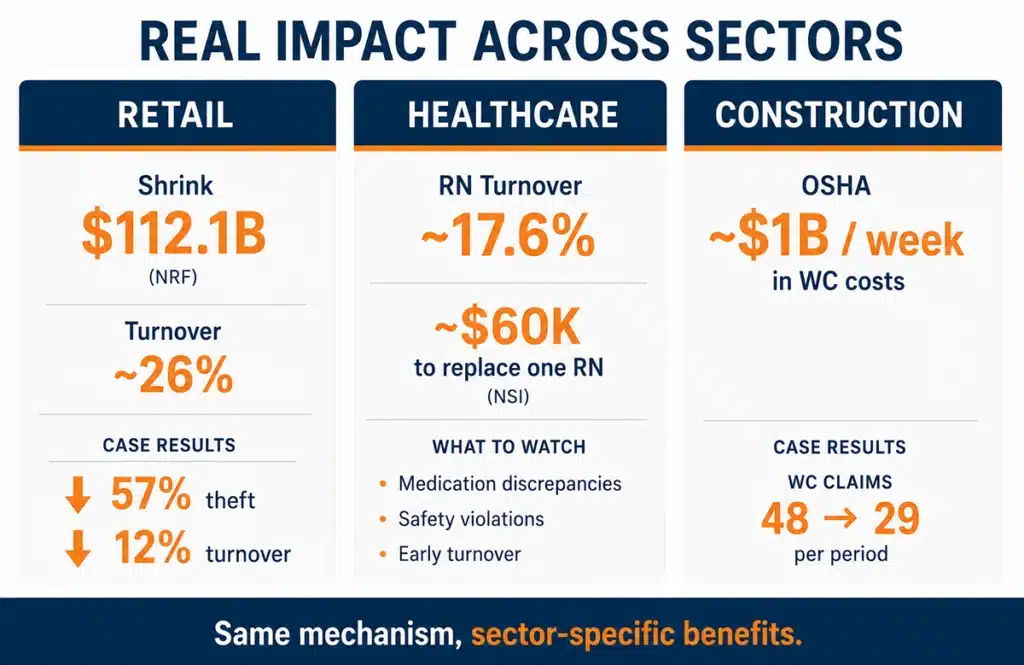
Retail lives on thin margins and constant hiring, which is exactly the environment where theft and turnover compound. Turnover routinely runs above 26 percent, and the NRF’s National Retail Security Survey pegged retail shrink at $112.1 billion in 2022, with internal and external theft driving roughly two-thirds of the total. In a high-volume pipeline, every point of per-hire reliability multiplies across hundreds of associates handling cash and merchandise.
The leverage cuts both ways, which is why the benefit is so visible here. Because retail hires in bulk, a small lift in the reliability of each new associate scales into a large swing in shrink and churn across a season, and a standardized screen keeps that bar consistent from one store to the next instead of varying with each manager’s judgment.
| What to watch in retail | Documented movement |
| Inventory shrink %, cash variance, involuntary turnover | −57% employee theft, −12% turnover in year one (case) |
Those figures come from our documented case data for a national retailer, and they land straight in recovered margin, the currency retail leadership already reports on.
Healthcare: Stability and Patient Safety
Healthcare is working through a retention crisis, sharpest in frontline and nursing roles. The NSI National Health Care Retention & RN Staffing Report puts registered-nurse turnover near 17.6%, with a single RN costing roughly $60,000 to replace and the average hospital losing millions a year to churn. Here an unreliable hire is not only a cost; it is a patient-safety exposure.
So the benefit is paid in reliability rather than inventory. In a setting where one careless or dishonest hire can compromise care and compliance at the same time, screening for accountability and emotional resilience before the offer is a form of risk control, and it helps administrators steady a fragile workforce and protect vulnerable patients.
| What to watch in healthcare | Why it matters |
| Medication-handling discrepancies, safety-rule violations, early-tenure turnover | Ties directly to patient safety, compliance, and staffing stability |
The strongest programs route lower-scoring candidates into a structured interview that probes attendance and reactions to supervision, rather than rejecting outright, keeping a stable roster around the clinical core and reducing the churn that so often forces expensive agency staffing.

Construction and Heavy Industry: Fewer Claims, Safer Sites
On a job site, an unreliable hire is a physical liability. OSHA’s business case for safety estimates that employers pay close to $1 billion a week in direct workers’ compensation costs for disabling injuries, many tied to preventable rule-bending. Crews depend on every worker following lockout-tagout and fall-protection procedures when a supervisor is on another floor, so a single corner-cutting hire raises everyone’s exposure.
Because claim history feeds the experience modifier that sets premiums, a safer year compounds into several years of lower insurance cost, which makes the benefit unusually durable in this sector. Lower turnover reinforces it, since crews that stay intact carry hard-won site-specific safety habits rather than relearning them with every replacement.
| What to watch in construction | Documented movement |
| OSHA-recordable rate, WC claim volume and cost, cost-per-hire | Annual WC claims cut from ~48 to ~29 (case) |
Weighting the integrity result most heavily for the roles with the greatest physical exposure turns a hiring step into a measurable part of the safety program. The retention side of the equation is covered in our analysis of how honesty tests reduce employee turnover, and the risk logic in our guide to integrity assessment for ethical hiring and risk reduction.

Reading the Benefit: What Doesn’t Change
Different sectors, different scorecards, but two things hold everywhere. First, the benefit only becomes visible if you capture a baseline before the screen goes live, then compare after by score band: shrink and cash variance in retail, medication discrepancies and early-tenure turnover in healthcare, OSHA-recordables and claim costs in construction. A number you never recorded cannot be shown to improve later, so the baseline is what turns a hunch into a defensible result.
Second, the screen is a signal, not a verdict. Across every sector, the score works best as one input in a structured process, with a low band triggering a documented follow-up rather than an automatic rejection. That discipline is also what keeps the program fair and defensible as the applicant pool changes. The mechanics are covered in our guides to using honesty and integrity tests in hiring and the research and evidence behind the tools, with a pure measurement view in our companion piece on honesty and integrity screening for better hiring outcomes.
Honesty and Integrity Assessment Benefits by Industry: Where to Start
You do not roll this out everywhere at once. Start with the one or two role families where a bad hire is most expensive, the cash-handling or high-shrink roles in retail, the frontline clinical and support roles in healthcare, the safety-sensitive trades in construction. Baseline their numbers, place the screen early in the funnel, set clear score bands, and review results by band after a couple of quarters.
Proving the benefit where the risk is highest gives you the internal evidence, and the executive credibility, to expand into adjacent roles on data rather than assumption. That sequencing is what separates a screen that quietly delivers year after year from one that gets questioned at the next budget review.
Frequently Asked Questions
What are the main honesty and integrity assessment benefits for HR?
A validated screen tilts each hire toward reliability, screening out the applicants most likely to engage in counterproductive behavior. That reduces incidents, which reduces terminations and turnover, which in turn rebuilds workforce trust, one step producing several connected benefits.
Do the benefits look the same in every industry?
The mechanism is the same, but the metrics differ. Retail tracks shrink and turnover, healthcare tracks patient-safety and retention measures, and construction tracks OSHA-recordable incidents and workers’ compensation claims.
Which sector sees the fastest return?
High-volume, high-exposure sectors, retail and frontline services, tend to show movement first because the screen touches so many hires and the loss events are frequent. Safety-driven results in construction and stability in healthcare build over a few quarters.
Is an integrity assessment enough on its own?
No. It works best as one input in a structured process, paired with a job-related interview and, where appropriate, a cognitive measure, with results tracked against your own baseline rather than a vendor’s headline.
How soon do the benefits appear?
Expect two to three quarters. Incident and theft signals can move first, while turnover and trust measures build over the following 6 to 12 months.
Put the Benefit to Work in Your Sector
The honesty and integrity assessment benefits by industry are real, but capturing them takes a screen matched to the risks that actually cost your sector money and safety. IntegrityFirst Tests gives HR a validated, fast integrity screen built for the pre-interview stage, tuned to what matters in retail, healthcare, and construction. Schedule an IntegrityFirst demo to target the outcomes your industry pays for.
When you want that screen wired into the rest of hiring, applicant tracking, scorecards, interview scheduling, and reporting, Discovered brings assessment and workflow into one system, so a result moves straight into the next step. IntegrityFirst supplies the integrity signal; Discovered connects it across the hiring process.