Schedule a call!
The typical organization loses about 5% of its revenue to occupational fraud every year, with a median loss of $145,000 per case, according to the ACFE’s 2024 Report to the Nations. And fraud is only the visible edge of workplace deviance. The rest, time theft, safety shortcuts, and conduct that quietly erodes a team, is harder to see and just as expensive. Screening for it is now common; proving it worked is not.
That is the gap this article closes. Honesty and integrity screening for better hiring outcomes is only as valuable as your ability to measure it, yet SHRM reports that just about one in five organizations tracks quality of hire in a rigorous way. The rest run on impressions. Here is how to define “better outcomes” in numbers a CFO respects, which KPIs actually move, and how to build a before-and-after scorecard that holds up when someone challenges it.
Why “Better Hiring Outcomes” Needs a Definition
The phrase means nothing until you attach metrics to it. For an integrity program, “better outcomes” comes down to two things you can count: fewer preventable losses and steadier tenure.
SHRM’s guidance on how to measure quality of hire treats quality of hire as a composite of performance, retention, and manager satisfaction, and warns that anything measured before month six mostly reflects onboarding. The useful window is 6 to 12 months. That timing fits an integrity screen, whose payoff shows up as fewer incidents and steadier attendance over quarters, not weeks.
Defining outcomes this way also protects the program. A moving number is far harder to cut than a vague sense that “screening helps,” so measurement is what turns the integrity screen from a questioned line item into a proven contributor.
Honesty and Integrity Screening for Better Hiring Outcomes: The KPIs That Matter
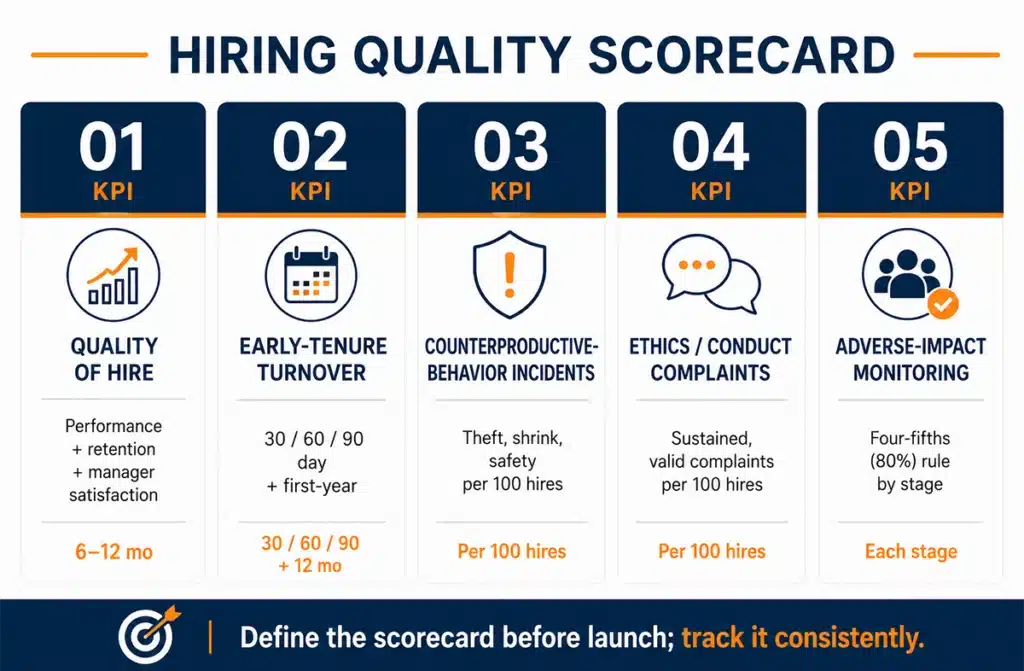
Decide the scorecard before launch, then track the same measures every quarter. Five KPIs carry most of the weight.
- Quality of hire. Performance, retention, and manager-satisfaction scores at 6 and 12 months, compared across integrity score bands, so you can see whether higher-scoring hires actually perform and stay.
- Early-tenure turnover. 30/60/90-day and first-year turnover, especially involuntary separations, where an integrity signal surfaces first and where replacement cost concentrates.
- Counterproductive-behavior incidents. Theft, shrink, policy violations, and safety write-ups per 100 hires, normalized so you can compare across sites and periods.
- Ethics and conduct complaints. Substantiated violations, a lagging but high-signal read on workforce trustworthiness and culture.
- Adverse-impact monitoring. Selection rates by protected group at each stage, watched with the EEOC’s four-fifths comparison, so fairness is measured continuously rather than assumed.
These KPIs matter because the cost behind them is steep: SHRM estimates that replacing an employee runs 50% to 200% of their annual salary, so even a few points off the turnover rate compounds quickly. Your own scorecard exists to show that movement in your numbers, not to borrow someone else’s headline.
A Before-and-After Scorecard
Numbers persuade leadership; adjectives do not. The cleanest proof is a baseline set against results after the screen goes live. In one documented rollout, a single implementation cycle moved three interlocking measures:
| KPI | Before | After | Change |
| Organizational trust index | 48% | 68% | +20 points |
| Annual involuntary turnover | 26% | 16% | −10 points |
| Recorded ethics violations | 19 | 6 | ~70% fewer |
The three move together for a reason. Screen out the small share of applicants whose profiles predict rule-breaking, and recorded ethics violations fall first. Fewer violations mean fewer terminations, which pulls involuntary turnover down. And as employees watch misconduct stop being tolerated, the trust index climbs. One screen, three connected results. For the dollar side of that chain, see our analysis of the ROI of honesty tests in hiring; for how risk assessment feeds the same metrics, our guide to integrity risk assessment for HR.
How to Measure It Credibly
A scorecard is only as good as the method behind it. Three disciplines separate real measurement from wishful attribution.
Set the baseline first. Capture turnover, incidents, and complaints for the target roles before the screen goes live, because a number you never recorded cannot be improved on paper later.
Compare like with like, and mind the variability. Track outcomes by score band or run a screened-versus-unscreened comparison over two or three quarters. This is also where recent science matters: Sackett and colleagues, in their 2023 analysis in Industrial and Organizational Psychology, argue that HR should attend to the variability of validity across settings, not just the average, which is precisely why you validate against your own results rather than a vendor’s best case.
Name the confounders. A new manager, a wage change, or a cooler labor market can move the same numbers, so the honest claim is that the screen contributed in a predictable direction, not that it caused everything. That candor is what makes the scorecard survive a hard question from finance or legal.

Common Measurement Mistakes
Even well-run programs undercut their own numbers in predictable ways. Four are worth guarding against.
- No baseline. Launching before recording pre-program turnover and incidents leaves nothing to compare against, and no credible claim of improvement.
- Measuring too early. Reading results at 30 or 60 days captures onboarding, not hire quality; the meaningful signal lands at 6 to 12 months.
- One number, no context. A single headline figure without selection-rate monitoring or named confounders invites both legal risk and skepticism.
- Vanity over validity. Tracking easy metrics like completion rate instead of the outcomes that cost money, turnover, shrink, conduct, makes a dashboard look busy without proving value.
Turning Metrics Into a Program
Measurement earns its keep when it changes decisions. Review the scorecard on a set cadence, adjust score bands and role thresholds where the data warrants, and drop the assumption that the program works simply because it is running.
The strongest programs close the loop back to selection: a low integrity band triggers a documented structured-interview follow-up, and the outcomes of those hires feed next quarter’s numbers. The deployment mechanics live in our guide to using honesty and integrity tests in hiring, and the evidence base in our review of honesty and integrity assessment research and evidence.
Frequently Asked Questions
What does “better hiring outcomes” actually mean for an integrity screen?
Fewer preventable losses and steadier tenure, expressed as measurable KPIs: quality of hire, early-tenure turnover, counterproductive-behavior incidents, conduct complaints, and monitored selection rates. If you cannot put a number on it, you cannot claim it.
When should we expect the numbers to move?
Give it two to three quarters. SHRM notes that hire-quality signals before month six mostly reflect onboarding, and an integrity screen’s payoff accrues over 6 to 12 months.
How do we prove the screen caused the improvement?
You rarely prove sole causation, and you should not claim it. Use a baseline and a by-score-band or screened-versus-unscreened comparison, name the confounders, and present the screen as a contributor in the direction the evidence predicts.
Which single metric matters most?
Quality of hire, because it blends performance, retention, and manager satisfaction into one business-relevant score. Track it beside adverse-impact monitoring so you never improve outcomes at the expense of fairness.
Measure Better Outcomes, Then Build On Them
Honesty and integrity screening for better hiring outcomes stops being a slogan the moment you attach a scorecard to it. IntegrityFirst Tests gives HR a validated, fast integrity screen built for the pre-interview stage, and results you can track against turnover, conduct, and quality-of-hire metrics. Schedule an IntegrityFirst demo to set up a program you can measure from day one.
When you want those metrics wired into the rest of hiring, applicant tracking, scorecards, interview scheduling, and reporting, Discovered brings assessment and workflow into one system, so the data lands where you can act on it. IntegrityFirst supplies the integrity signal; Discovered connects it to the numbers you report.