Schedule a call!
By the time a hiring problem reaches the HR leadership level, it is rarely about one bad hire.
It is usually a pattern.
A region is seeing early turnover in the same role family. A staffing team is moving quickly but sending too many risky placements to clients. A construction or logistics operation is dealing with attendance, claims, conduct, or safety issues that appear shortly after start date. Store managers are hiring under pressure and applying different standards from one location to another.
At that point, the question for HR leadership is no longer, “Should we add a test?”
The better question is: What kind of hiring risk are we trying to control, and how should the organization manage that risk consistently?
That is where an honesty and integrity test strategy for HR leaders becomes valuable. The strategy is not only about choosing an assessment. It is about deciding where the test belongs, which roles need it, how results will be used, who owns exceptions, what data will be reviewed, and how the process supports the culture the company is trying to build.
For a hands-on implementation guide, read How to Use Honesty and Integrity Tests in Hiring. This article focuses on the leadership strategy behind the program.
Why HR Leaders Should Treat Integrity Testing as a Governance Issue
Honesty and integrity testing affects more than recruiter efficiency.
It affects hiring standards, candidate experience, compliance documentation, manager behavior, workforce risk, and the company’s ability to explain how selection decisions are made.
That makes it a governance issue.
If the program is designed only as a recruiting tool, it may solve a short-term screening problem but create long-term inconsistency. One location may use the assessment early. Another may use it late. One manager may override results casually. Another may treat the test as an automatic rejection tool. Recruiters may explain it differently to candidates.
A leadership-level strategy prevents that.
The U.S. Office of Personnel Management describes integrity and honesty tests as tools used to assess whether an applicant is likely to be honest, trustworthy, and dependable. OPM also connects low integrity with counterproductive workplace behaviors such as theft, absenteeism, sabotage, disciplinary problems, and violence. OPM integrity/honesty tests.
For HR leaders, the implication is clear: if the test is being used to manage workforce risk, then the operating model around the test matters as much as the test itself.
Start With the Business Risk, Not the Vendor
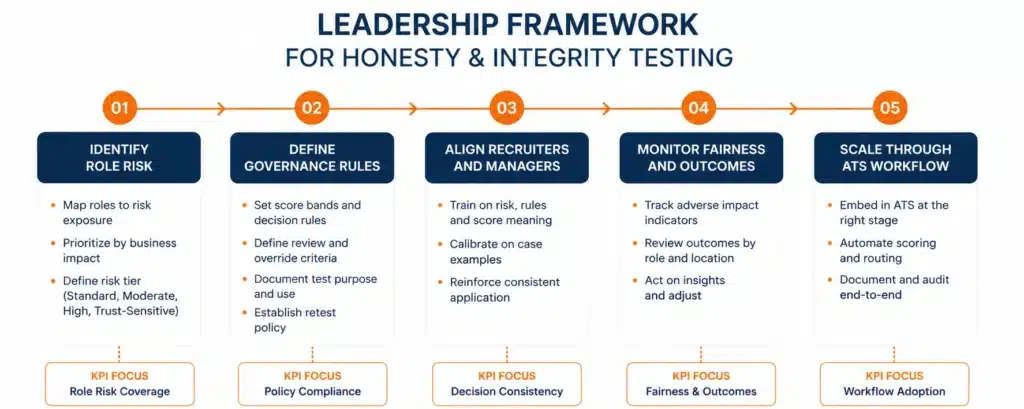
The wrong way to build the strategy is to start with a feature comparison.
The better starting point is a leadership discussion about business risk.
Which roles are creating the most preventable hiring cost?
Where does early turnover hurt the business most?
Which roles expose the company to claims, safety issues, theft, client complaints, or conduct concerns?
Where are managers making inconsistent hiring decisions?
Where is recruiter time being spent on candidates who should not have moved forward?
Those questions help HR identify where honesty and integrity testing belongs.
| Business issue | Strategic use of the test |
| Early turnover in frontline roles | Screen for reliability and dependability before interviews |
| Claims or safety exposure | Add integrity screening to risk-sensitive roles |
| Inconsistent manager standards | Use shared result bands and documented review paths |
| High-volume recruiting pressure | Reduce manual review before recruiter or manager time |
| Client-facing placement risk | Apply consistent screening before assignment |
| Multi-location hiring variation | Standardize timing, communication, and result use |
The strategy should not aim to test everyone for everything. It should identify the role families where honesty, reliability, accountability, and conduct risk matter enough to justify a structured screening step.
For definition and test format context, read Honesty and Integrity Test Definition and Types for HR.
Segment Roles by Risk Level

A leadership strategy needs more than a yes-or-no decision about testing.
It needs role segmentation.
Not every role carries the same level of integrity exposure. A receptionist, driver, warehouse associate, field technician, caregiver, cashier, supervisor, and executive may all require trust. But the operational risk looks different.
A practical segmentation model might look like this:
| Risk tier | Role characteristics | Recommended approach |
| Tier 1: Standard risk | Limited access to assets, low safety exposure, close supervision | Use standard hiring process; assessment optional |
| Tier 2: Moderate risk | Customer-facing, inventory access, attendance-sensitive, team reliability impact | Use honesty and integrity test after minimum qualifications |
| Tier 3: High risk | Safety-sensitive, unsupervised work, cash/tools/client property access, client placement exposure | Use required assessment with documented review path |
| Tier 4: Leadership or trust-sensitive | Supervisory authority, culture impact, policy enforcement responsibility | Use assessment as part of broader leadership evaluation |
This approach helps HR avoid two common mistakes: over-testing low-risk roles and under-testing roles where a poor hire has real business cost.
For candidate selection methodology, connect this strategy to Honesty and Integrity Tests for Candidate Selection.
Define How Results Will Influence Decisions
HR leaders should not allow every recruiter, branch manager, or hiring manager to decide independently what test results mean.
Before rollout, define how results affect movement through the hiring process.
A practical decision model uses bands:
| Result | Strategic meaning | Process rule |
| Qualified | Candidate meets the integrity standard for the role family | Continue to next step |
| Review | Risk signals require secondary review | Escalate to approved review owner |
| Not qualified | Candidate does not meet the defined standard | Follow approved disposition process |
| Incomplete | Required step not completed | Send reminder or close after deadline |
The most important part is the “Review” process.
This is where leadership discipline matters. A review category without rules will quickly become inconsistent. HR should define who reviews the result, what information can be considered, how long review should take, when an exception is allowed, and where the decision is documented.
For more practical workflow detail, use How to Use Honesty and Integrity Tests in Hiring.
Build the Compliance Model Before Launch
A test strategy should be built with compliance in the room from the beginning.
The EEOC explains that employment tests and selection procedures can help employers evaluate applicants, but they may create legal issues if used in a discriminatory way or if they disproportionately exclude protected groups without proper justification. EEOC employment tests and selection procedures.
The Uniform Guidelines on Employee Selection Procedures apply to tests and other selection procedures used as the basis for employment decisions, including hiring, promotion, referral, retention, and related decisions. Uniform Guidelines on Employee Selection Procedures.
For HR leaders, this means the strategy should document:
- which role families receive the test,
- why the test is job-related for those roles,
- when the test is used in the process,
- how results influence candidate movement,
- who can override or review results,
- where results are stored,
- how candidate communication is handled,
- how adverse impact and outcomes will be monitored.
The goal is not to turn every hiring step into a legal memo. The goal is to make the program consistent enough to explain and improve.
Connect the Program to Culture Without Overstating It
Leaders often want integrity testing to support a culture of trust. That can be appropriate, but the message needs to be handled carefully.
A test does not create culture by itself.
Culture is created by what leaders reward, what managers tolerate, how policies are enforced, and how employees are treated after hire. An honesty and integrity test can support that culture by helping the company select candidates who are more likely to align with expectations around accountability, honesty, safety, and reliability.
The leadership message should be practical:
“We use integrity screening because our roles require trust, consistency, and accountability. The assessment helps us apply those expectations more consistently before the hire.”
That framing is stronger than saying the test “guarantees trust” or “eliminates bad hires.”
For adjacent B3 assessment content, read Honesty and Integrity Assessment for HR Teams and Honesty and Integrity Assessment for Smarter Hiring.
Secure C-Suite Buy-In With Business Metrics
Executives are unlikely to support an assessment program because HR wants another screening step.
They will support it if the program is tied to business outcomes.
For leadership approval, connect the strategy to metrics such as:
| Executive concern | Metric to track |
| Turnover cost | Early turnover by role family |
| Claims exposure | Claims rate, severity, and trend |
| Safety | Incidents, near misses, OSHA-recordable events where relevant |
| Attendance | Absenteeism, no-call/no-show, schedule reliability |
| Recruiting efficiency | Time-to-interview, recruiter screen pass-through |
| Manager confidence | Interview-to-offer conversion and shortlist quality |
| Consistency | Override frequency and review case resolution |
| Fairness | Adverse impact monitoring and process consistency |
The business case should be specific. A broad claim like “this improves hiring” is less useful than: “We want to reduce first-90-day turnover in warehouse roles, lower claim exposure in field placements, and reduce recruiter time spent on candidates who do not meet our reliability standard.”
For a data-first view of evidence and KPIs, connect this article to Data-Driven Honesty and Integrity Test for Employee Selection.
Pilot the Strategy Before Scaling
A leadership strategy should still start with a pilot.
The difference is that the pilot should be designed to test both the assessment and the operating model around it.
Choose one role family or business unit where the risk is clear. Define baseline metrics before launch. Train recruiters. Align hiring managers. Document review rules. Then measure what changes.
A useful pilot plan includes:
| Pilot area | Leadership decision |
| Role family | Which roles are included and why |
| Stage placement | When the test is sent |
| Candidate communication | How the test is explained |
| Result use | How bands affect movement |
| Review ownership | Who handles exceptions |
| Data cadence | How often results are reviewed |
| Success measures | Which business outcomes matter |
During the pilot, leadership should watch for adoption issues. If recruiters bypass the test, the process may be too manual. If managers override results frequently, the decision rules may need refinement. If candidates abandon the assessment, the communication or timing may need work.
The pilot should end with a decision: scale, adjust, or stop.
Manage False Positives and False Negatives at Scale
At the leadership level, honesty and integrity testing should be managed as a risk tool, not a perfect prediction system.
A false positive means a candidate is flagged as risky but may have been a good hire. A false negative means a candidate passes but later creates issues.
Both are important.
A mature strategy does not pretend these issues disappear. It manages them through:
- role-specific standards,
- review bands,
- documented exceptions,
- outcome monitoring,
- periodic score review,
- recruiter training,
- adverse impact analysis,
- post-hire data comparison.
This is why leadership should avoid overly rigid implementation. A review band may be more operationally sound than a single hard cutoff in many hiring environments.
Make the ATS or Hiring Platform Part of the Strategy
If the assessment lives outside the hiring workflow, adoption will depend on recruiter discipline alone.
That is not a strategy.
For scale, assessment status, result bands, next steps, and review notes should be visible in the ATS or hiring platform. Recruiters should not have to search separate systems, download reports, or manually update status fields.
Discovered’s applicant tracking system is positioned to help teams organize candidates, automate workflows, and make faster hiring decisions across the team. Discovered Applicant Tracking System.
For HR leaders, this matters because the technology environment shapes the operating model. A strong integrity testing strategy should connect screening, recruiter action, manager review, documentation, and reporting in one hiring workflow.
For broader assessment infrastructure, connect this article to Talent Assessment Tools for HR Hiring.
What HR Leaders Should Review Quarterly

Once the program is live, leadership should review the data on a consistent cadence.
A quarterly review can cover:
| Review area | Questions to ask |
| Usage | Are the right role families using the test? |
| Completion | Are candidates completing it at acceptable rates? |
| Distribution | Are Qualified, Review, and Not Qualified bands stable? |
| Overrides | Who is overriding results and why? |
| Review cases | Are review cases resolved consistently? |
| Outcomes | Are turnover, claims, absenteeism, or incidents improving? |
| Fairness | Are adverse impact indicators being reviewed? |
| Adoption | Are recruiters and managers using the process correctly? |
| Workflow | Is the ATS or hiring platform supporting the process? |
The review should not be a dashboard ritual. It should produce decisions: adjust role coverage, refine messaging, retrain managers, update review rules, or expand the program.
FAQ
What is an honesty and integrity test strategy for HR leaders?
An honesty and integrity test strategy for HR leaders is a structured plan for using integrity testing across role families, hiring workflows, compliance review, recruiter adoption, manager alignment, KPI tracking, and workforce risk management.
Which roles should HR leaders prioritize first?
Start with roles where reliability, conduct, attendance, safety, theft risk, client trust, or claims exposure create measurable business cost. Frontline, staffing, logistics, construction, manufacturing, retail, hospitality, healthcare support, transportation, and field roles are common starting points.
Should an integrity test be used as an automatic rejection tool?
Not always. Some organizations use defined cutoffs, but many benefit from a review band that allows structured secondary review before final disposition. The rule should be defined before launch and applied consistently.
How should HR leaders measure success?
Track completion rate, result distribution, review rate, override frequency, recruiter adoption, early turnover, absenteeism, claims or incidents, time-to-interview, and adverse impact review.
How does an integrity test support company culture?
It supports culture by helping HR apply expectations around honesty, accountability, reliability, safety, and rule-following before the hire. It should reinforce culture, not be presented as the only source of trust.
How often should HR review the strategy?
During pilot, review monthly. After rollout, a quarterly review is usually practical for evaluating adoption, outcomes, fairness, and workflow performance.
Final Takeaway
For HR leaders, honesty and integrity testing is not just a screening tactic. It is a way to make hiring risk more visible, more consistent, and easier to manage across teams and locations.
A strong honesty and integrity test strategy for HR leaders starts with role risk, not vendor features. It defines who takes the test, when it appears in the workflow, how results influence decisions, how exceptions are handled, and which outcomes leadership will monitor.
For employers that need a focused pre-interview screen, IntegrityFirst Tests helps evaluate honesty, accountability, reliability, and workforce risk before recruiters and managers invest more time. IntegrityFirst is designed for practical use in high-volume and risk-sensitive hiring workflows, including staffing, construction, logistics, manufacturing, healthcare support, retail, hospitality, transportation, and field roles.
For companies that want that assessment connected to the broader hiring process, Discovered brings applicant tracking, workflows, assessments, candidate communication, scorecards, interviews, and automation into one platform.
IntegrityFirst gives HR the focused honesty and integrity signal.
Discovered gives HR the connected hiring system around it.
To reduce hiring risk with a focused integrity screen, schedule an IntegrityFirst demo.
To connect assessments with ATS workflows, scorecards, communication, interviews, and automation, book a Discovered demo.