Schedule a call!
One manager moves quickly because the role has been open too long. Another waits for a perfect candidate. One recruiter flags reliability concerns early. Another focuses mostly on experience. A staffing team may send candidates to clients under pressure, while operations later deals with attendance issues, conduct problems, safety concerns, or replacement costs. That is when HR needs more than a test. It needs a program.
Honesty integrity tests for hiring programs help HR teams introduce a consistent screening step for roles where reliability, accountability, workplace conduct, rule-following, and trust matter before day one. The goal is not to make the hiring process more complicated. The goal is to make the process easier to repeat, explain, measure, and improve.
For a broader methodology on honesty and integrity assessment, read Honesty and Integrity Assessment for Smarter Hiring. This guide focuses on how to turn screening into a hiring program that can work across roles, locations, recruiters, and managers.
What Makes This a Hiring Program, Not Just a Test
A test is a tool. A hiring program is the operating model around the tool.
That distinction matters.
A company can buy a strong assessment and still get poor results if recruiters do not know when to send it, managers do not understand what the result means, candidates receive confusing instructions, and HR has no way to monitor outcomes.
A hiring program defines:
| Program element | What HR needs to decide |
| Role scope | Which jobs require honesty and integrity screening |
| Timing | When the assessment appears in the hiring workflow |
| Candidate communication | How the test is explained |
| Result bands | What Qualified, Review, and Not Qualified mean |
| Review path | Who handles borderline or escalated cases |
| Hiring manager guidance | What managers should and should not see |
| Documentation | Where decisions and exceptions are stored |
| KPIs | How HR measures whether the program is working |
That structure gives recruiters a repeatable process instead of another task to manage.
For a more tactical how-to, connect this article with How to Use Honesty and Integrity Tests in Hiring.
Step 1: Choose the Role Families First

The first program decision is scope.
Not every role needs the same screening process. A corporate analyst, warehouse associate, field technician, cashier, caregiver, driver, supervisor, and temporary placement may all require trust, but the risk is not the same.
Start with roles where a poor hire creates measurable operational cost.
Common priority groups include:
| Role family | Why honesty and integrity screening may matter |
| Staffing and temporary placement | Fast hiring cycles and client trust exposure |
| Construction and field work | Safety, attendance, tool use, and rule-following |
| Logistics and transportation | Dependability, schedule reliability, and policy adherence |
| Retail and hospitality | Cash, inventory, customer interaction, and conduct risk |
| Manufacturing and warehouse | Safety, consistency, attendance, and workplace rules |
| Healthcare support | Reliability, documentation, care standards, and client trust |
| Unsupervised roles | Accountability when managers are not present |
This is where HR should be specific. “All hourly roles” may be too broad. “Warehouse, driver, field technician, caregiver, and client-placement roles” is easier to explain and manage.
For related role-risk thinking, read Integrity and Honesty in Hiring to Assess Trust.
Step 2: Define the Screening Objective
A hiring program should have a clear business reason.
If leadership cannot explain why the assessment is being used, recruiters and managers will treat it as another HR requirement.
The objective may be:
- reduce early turnover,
- improve attendance reliability,
- lower preventable claims or incidents,
- reduce conduct issues,
- improve client placement quality,
- create more consistent screening across locations,
- reduce wasted recruiter and manager interview time,
- document selection decisions more clearly.
The objective determines how the program should be measured.
For example, if the concern is early turnover, HR should track first-30, first-60, and first-90-day retention. If the concern is safety or claims, HR should track relevant incidents or claim trends where appropriate. If the concern is recruiter efficiency, HR should track pass-through rates and time-to-interview.
For a data-focused approach, read Data-Driven Honesty and Integrity Test for Employee Selection.
Step 3: Place the Test at the Right Stage
Placement determines whether the program is useful or disruptive.
For many high-volume or risk-sensitive hiring programs, the assessment works best after minimum qualifications and before recruiter or hiring manager interviews.
A practical flow looks like this:
Application received
Minimum qualifications reviewed
Honesty and integrity test sent
Candidate completes the assessment
Result band appears in the hiring workflow
Qualified candidates move forward
Review candidates receive structured review
Not qualified candidates follow the approved disposition process
This placement protects recruiter time without creating unnecessary friction for applicants who are not basically qualified.
If the assessment is sent too early, candidates who do not meet basic requirements may still be tested. If it is sent too late, managers may already be invested in the candidate and more likely to discount risk signals.
For ATS workflow design, connect this article to How to Implement Talent Assessment Tools in ATS Workflows.
Step 4: Create a Candidate Message Recruiters Can Reuse
Candidate communication should not be improvised.
Recruiters need a simple, approved explanation that works across roles and locations.
A candidate message can be as direct as:
“Please complete this short pre-employment assessment as the next step in your application. It helps us evaluate candidates consistently for this role and can be completed from any device.”
That message does three things well:
- It explains the step.
- It connects the step to consistency.
- It avoids language that sounds accusatory.
Do not describe the assessment as a test to “catch” dishonest people. Do not tell candidates it will “prove” integrity. Do not make it sound like a moral investigation.
The tone should be clear, professional, and routine.
For candidate-facing definitions and test formats, read Honesty and Integrity Test Definition and Types for HR.
Step 5: Use Result Bands That Fit the Program
A hiring program needs outputs that recruiters can use quickly.
A long report may be useful in some settings, but most high-volume hiring teams need clear result bands and next steps.
| Result band | Program meaning | Next step |
| Qualified | Candidate meets the defined standard for the role family | Continue hiring process |
| Review | Candidate requires structured secondary review | Escalate to approved reviewer |
| Not qualified | Candidate does not meet the defined standard | Follow approved disposition process |
| Incomplete | Candidate did not complete the required step | Send reminder or close after deadline |
The “Review” band is important because it protects the program from becoming too rigid. It gives HR a place to evaluate context without allowing every recruiter to create a different standard.
A review path should define:
- who owns the review,
- how quickly it should happen,
- what information may be considered,
- which follow-up questions are approved,
- when an exception is allowed,
- where the decision is documented.
For selection-specific guidance, read Honesty and Integrity Tests for Candidate Selection.
Step 6: Train Recruiters on Decisions, Not Just Software
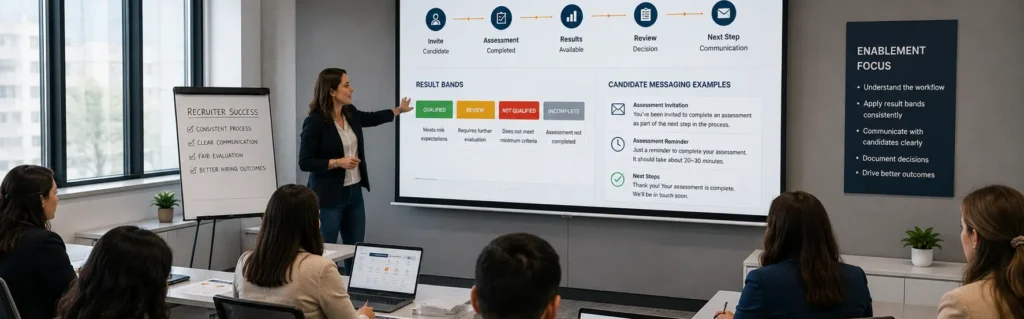
A program can be technically live and still fail in practice.
Recruiters need more than login instructions. They need to understand how the assessment fits into the hiring decision.
Training should cover:
- which roles receive the assessment,
- when the assessment is sent,
- how to explain it to candidates,
- where results appear,
- what each result band means,
- when to escalate a review case,
- how to document exceptions,
- what hiring managers should receive,
- what not to say to candidates.
A recruiter should be able to explain the program in one sentence:
“We use this short assessment to evaluate honesty, reliability, and workplace risk consistently for this role.”
If recruiters cannot explain it, the program is not ready to scale.
For HR function-wide rollout, use Honesty and Integrity Assessment for HR Teams.
Step 7: Give Hiring Managers a Controlled Summary
Hiring managers should not be asked to interpret detailed assessment reports on their own.
That can create inconsistent decisions. One manager may treat a result as absolute. Another may ignore it because the candidate interviewed well. Another may ask follow-up questions that HR has not approved.
A better program gives managers a concise summary.
| Candidate status | Manager-facing guidance |
| Qualified | Candidate may proceed to interview |
| Review | HR is completing secondary review before next step |
| Not qualified | Candidate will not proceed under the approved process |
| Incomplete | Candidate has not completed the required step |
If a follow-up interview question is appropriate, HR should provide approved language tied to the role.
For example:
“Tell me about a time you had to follow a workplace rule you disagreed with.”
“Describe a time you made a mistake at work. What did you do next?”
“Have you ever seen a coworker take a shortcut that created risk? How did you respond?”
The goal is not to trap the candidate. The goal is to evaluate judgment and accountability consistently.
Step 8: Build Compliance Into the Program
A hiring program that uses assessment results should be designed with compliance in mind from the beginning.
The U.S. Office of Personnel Management describes integrity and honesty tests as tools used to assess whether an applicant is likely to be honest, trustworthy, and dependable. OPM also connects low integrity with counterproductive workplace behaviors such as theft, absenteeism, sabotage, disciplinary problems, and violence.
The EEOC explains that employment tests and selection procedures can help employers evaluate applicants, but they can also create legal issues if used in a discriminatory way or if they disproportionately exclude protected groups without proper justification.
The Uniform Guidelines on Employee Selection Procedures apply to tests and other selection procedures used as the basis for employment decisions.
For HR, the practical compliance model should define:
| Area | Program rule |
| Job relevance | Why the role family uses the assessment |
| Consistency | Which candidates receive it and when |
| Result use | How bands affect movement or review |
| Overrides | When exceptions are allowed |
| Documentation | Where decisions and reasons are stored |
| Data access | Who may view results |
| Monitoring | How outcomes and adverse impact are reviewed |
The program does not need to be slow. It needs to be explainable.
Step 9: Measure the Program After Launch
The number of tests sent is not the business result.
A hiring program should be measured by whether the process improves decisions, reduces friction, and supports better workforce outcomes.
Track:
| Metric | Why it matters |
| Invitation rate | Confirms the program is being applied |
| Completion rate | Shows whether candidates can complete the step easily |
| Time to completion | Reveals candidate friction |
| Qualified / Review / Not qualified distribution | Shows how results move through the funnel |
| Review-case resolution time | Measures process efficiency |
| Override frequency | Reveals pressure, confusion, or misalignment |
| Recruiter adoption | Shows whether teams use the process correctly |
| Hiring manager acceptance | Shows whether managers trust the shortlist |
| Time-to-interview | Measures recruiting efficiency |
| Early turnover | Tracks post-hire quality |
| Absenteeism | Useful for frontline roles |
| Claims or incidents | Relevant for risk-sensitive environments |
| Adverse impact review | Supports fairness monitoring |
During pilot, review these metrics frequently. Once the program stabilizes, a quarterly review may be enough to decide whether to adjust, expand, retrain, or refine the workflow.
Step 10: Start With a Pilot, Then Scale
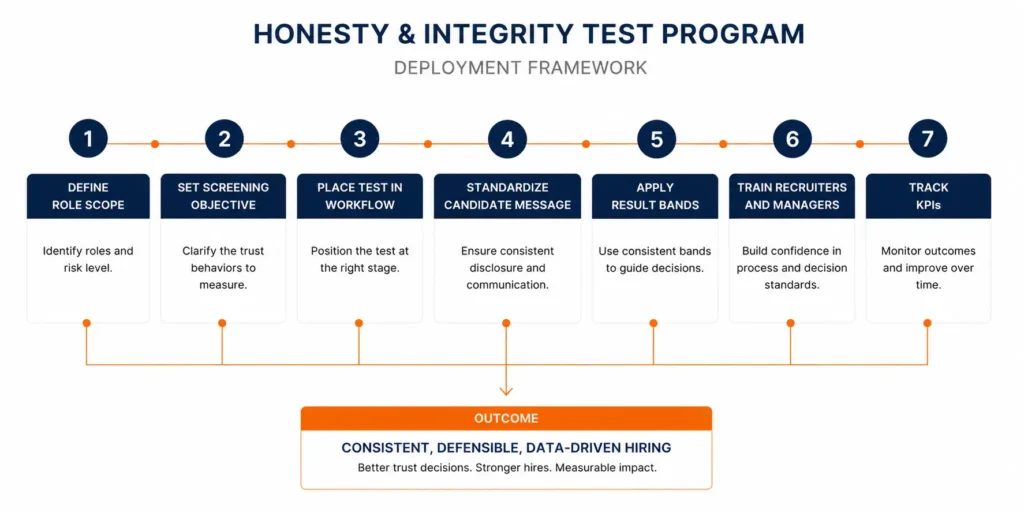
A hiring program should not start with every location, every role, and every recruiter at once.
Begin with one role family where the business problem is clear.
A pilot plan should include:
- Role family and locations included
- Baseline hiring and workforce metrics
- Assessment stage in the workflow
- Candidate message
- Result bands
- Review owner
- Recruiter training
- Hiring manager guidance
- Compliance documentation
- KPI review cadence
The pilot should test the process under real hiring pressure.
If candidates do not complete the assessment, adjust the timing or message. If recruiters bypass it, improve the workflow. If managers do not understand the summary, simplify it. If review cases pile up, assign ownership more clearly.
A good pilot is not just a software launch. It is a test of whether the program can survive daily hiring operations.
For leadership strategy, connect this article to Integrity and Honesty Assessment Strategies for HR Leaders.
What to Avoid When Building the Program
Starting With Vendor Features
Features matter, but the program should start with role risk, business outcomes, and workflow design.
Testing Every Applicant Too Early
Minimum qualifications should usually come first. Otherwise, the company may create friction for candidates who were never eligible.
Letting Managers Interpret Reports Freely
Managers need approved summaries and next steps, not uncontrolled interpretation.
Skipping the Review Path
If “Review” has no owner, it becomes a bottleneck.
Treating the Assessment as a Guarantee
No assessment proves future behavior. It provides a structured signal that should be used with other hiring inputs.
Measuring Activity Instead of Outcomes
Assessment volume is not success. Better hiring outcomes are.
FAQ
What are honesty integrity tests for hiring programs?
Honesty integrity tests for hiring programs are structured screening tools used inside a repeatable hiring model to evaluate honesty, reliability, accountability, and workplace risk before candidates move too far into the process.
How is a hiring program different from using one test?
A test is the assessment itself. A hiring program includes role scope, candidate messaging, workflow timing, result bands, review rules, recruiter training, manager guidance, documentation, and KPI tracking.
Where should the test sit in the hiring program?
For many high-volume or risk-sensitive roles, it works best after minimum qualifications and before recruiter or hiring manager interviews.
Should candidates be automatically rejected based on the test?
Not always. Some programs may use defined cutoffs, but many employers benefit from a Review band that allows structured secondary review before a final decision.
Which roles benefit most from these programs?
Staffing, construction, logistics, transportation, manufacturing, healthcare support, retail, hospitality, warehouse, field, and high-volume hourly roles often benefit because reliability, safety, conduct, attendance, and trust matter from day one.
What should HR measure after launch?
HR should measure completion rate, result distribution, review-case resolution, override frequency, recruiter adoption, time-to-interview, early turnover, absenteeism, claims or incidents, hiring manager acceptance, and adverse impact review.
Final Takeaway
A hiring program succeeds when recruiters know what to do, managers understand the process, candidates receive clear communication, and HR can measure whether outcomes improve.
That is the value of honesty integrity tests for hiring programs. They help HR move from inconsistent judgment to a more repeatable screening model for roles where honesty, reliability, accountability, and workplace risk matter.
For employers that need a focused pre-interview screen, IntegrityFirst Tests helps evaluate honesty, accountability, reliability, and workforce risk before recruiters and managers invest more time. It is especially useful for high-volume and risk-sensitive hiring environments where conduct, dependability, attendance, safety, claims, and turnover create real business cost.
For companies that want that assessment connected to the broader hiring workflow, Discovered brings applicant tracking, workflows, assessments, candidate communication, scorecards, interviews, and automation into one platform.
IntegrityFirst gives HR the focused honesty and integrity signal.
Discovered gives HR the connected hiring system around it.
To reduce hiring risk with a focused integrity screen, schedule an IntegrityFirst demo.
To connect assessments with ATS workflows, scorecards, communication, interviews, and automation, book a Discovered demo.