Schedule a call!
Hiring teams often treat integrity as something they hope to discover during the interview. That is not enough.
A candidate may speak confidently, answer common questions well, and still create problems after hire. Attendance issues, conduct concerns, safety shortcuts, policy violations, theft risk, unreliable follow-through, and poor accountability rarely appear clearly in a resume. They often show up later, after the offer, after onboarding, and after managers have already invested time.
That is why integrity and honesty in the hiring process for HR should be designed intentionally.
The goal is not to turn hiring into an interrogation. The goal is to build a process where trust, reliability, accountability, and workplace conduct are evaluated consistently across the right stages of the funnel.
A strong process does not rely on one test, one interview answer, or one manager’s instinct. It connects role-risk criteria, honesty and integrity assessment, structured interviews, reference patterns, review bands, compliance documentation, and post-hire outcomes.
For a trust-specific view, read Integrity and Honesty in Hiring to Assess Trust. This article focuses on process design: where integrity and honesty should appear inside the hiring workflow.
Start by Defining What Integrity Means for the Role
Integrity is too broad to leave undefined.
For one role, integrity may mean showing up on time, following safety procedures, and reporting mistakes. For another, it may mean handling cash, tools, inventory, or client property responsibly. For a healthcare support role, it may include documentation accuracy, reliability, and care standards. For a field role, it may include judgment when no supervisor is nearby.
HR should translate integrity into role-specific expectations before adding an assessment or interview question.
| Role context | Integrity and honesty may include |
| Cash handling | Accurate transactions, theft prevention, policy adherence |
| Inventory or tools | Responsible use, reporting loss or damage, respect for property |
| Safety-sensitive work | Rule-following, judgment, incident reporting |
| Client-facing work | Reliability, professionalism, truthful communication |
| Unsupervised work | Accountability when managers are not present |
| Healthcare support | Documentation accuracy, care standards, attendance reliability |
| Staffing or temporary placement | Client trust, dependability, conduct consistency |
This step matters because a hiring process can only evaluate what it has defined.
A vague requirement like “must have integrity” does not help recruiters, candidates, or hiring managers. A role-specific standard does.
For the foundational test category, use Honesty and Integrity Test for HR and Honesty and Integrity Test Definition and Types for HR.
Build Integrity Into the Funnel, Not Around It

Integrity and honesty should not be handled as a disconnected step.
If assessment results sit outside the ATS, if recruiters have to search another system, or if hiring managers receive unclear reports with no guidance, the process becomes inconsistent.
A better model places integrity checks inside the hiring workflow. A practical funnel may look like this:
- Application received
- Minimum qualifications reviewed
- Honesty and integrity assessment sent
- Assessment result reviewed
- Qualified candidates continue
- Review candidates receive structured follow-up
- Not qualified candidates follow approved disposition process
- Structured interview confirms job-related behaviors
- References support or challenge the trust picture
- Offer decision is documented
- Post-hire outcomes are tracked
The important point is sequence. The assessment should usually come after basic qualifications and before major interview investment. That gives HR an early risk signal without assessing candidates who were never eligible.
For the step-by-step version, read How to Use Honesty and Integrity Tests in Hiring.
Use the Assessment as an Early Signal, Not the Whole Decision
A honesty and integrity assessment gives HR a structured way to evaluate trust-related risk before the interview becomes the decision. It may help identify patterns related to:
- honesty,
- dependability,
- accountability,
- rule-following,
- workplace conduct,
- reliability,
- attendance risk,
- safety shortcuts,
- theft or misuse risk,
- response to supervision,
- willingness to report problems.
The assessment should not be treated as a perfect prediction of future behavior. It should be treated as one job-related input in a broader decision process. A strong process combines:
| Hiring input | What it contributes |
| Minimum qualifications | Confirms basic eligibility |
| Honesty and integrity assessment | Adds early signal on reliability, accountability, and conduct risk |
| Structured interview | Adds examples, context, judgment, and communication |
| Reference checks | Adds past behavior patterns where available |
| Hiring manager review | Adds role-specific evaluation |
| Post-hire outcomes | Confirms whether the process is improving over time |
This approach is more defensible than relying only on a manager’s impression.
For assessment methodology, connect this article to Honesty and Integrity Assessment for Smarter Hiring.
Create Result Bands Recruiters Can Actually Use
Recruiters do not need a long report with no next step. They need a result that fits the workflow. Use result bands tied to defined actions:
| Result band | Meaning | Process action |
| Qualified | Candidate meets the defined integrity standard for the role | Continue to the next step |
| Review | Some risk signals require structured secondary review | Escalate to approved reviewer |
| Not qualified | Candidate does not meet the role standard | Follow approved disposition process |
| Incomplete | Candidate did not complete the assessment | Send reminder or close after deadline |
The “Review” band is especially important.
Without it, the process can become too rigid or too subjective. A recruiter may screen out a candidate too quickly, while a hiring manager may push another candidate forward without documentation. A structured review path gives HR a way to handle nuance. The review path should define:
- who owns the review,
- how quickly review should happen,
- what information may be considered,
- which follow-up questions are approved,
- when an override is allowed,
- where the final decision is documented.
For candidate selection methodology, use Honesty and Integrity Tests for Candidate Selection.
Train Recruiters on the Integrity Conversation
The recruiter’s explanation shapes the candidate experience.
If the assessment is described poorly, candidates may feel accused or confused. If recruiters use different explanations, the process becomes inconsistent across locations.
A good recruiter explanation is simple: “We use this short assessment to evaluate honesty, reliability, and workplace risk consistently for this role.”
Candidate-facing language can be just as direct: “Please complete this short pre-employment assessment as the next step in your application. It helps us evaluate candidates consistently for this role and can be completed from any device.”
Avoid language like:
“This test proves whether you are honest.”
“We use this to catch risky candidates.”
“You must prove your integrity before moving forward.”
The tone should be clear, neutral, and routine.
Recruiters should also know what not to do. They should not interpret detailed psychological meaning, improvise compliance language, or promise that one result determines the full hiring decision.
For HR team rollout, read Honesty and Integrity Assessment for HR Teams.
Give Hiring Managers Guardrails
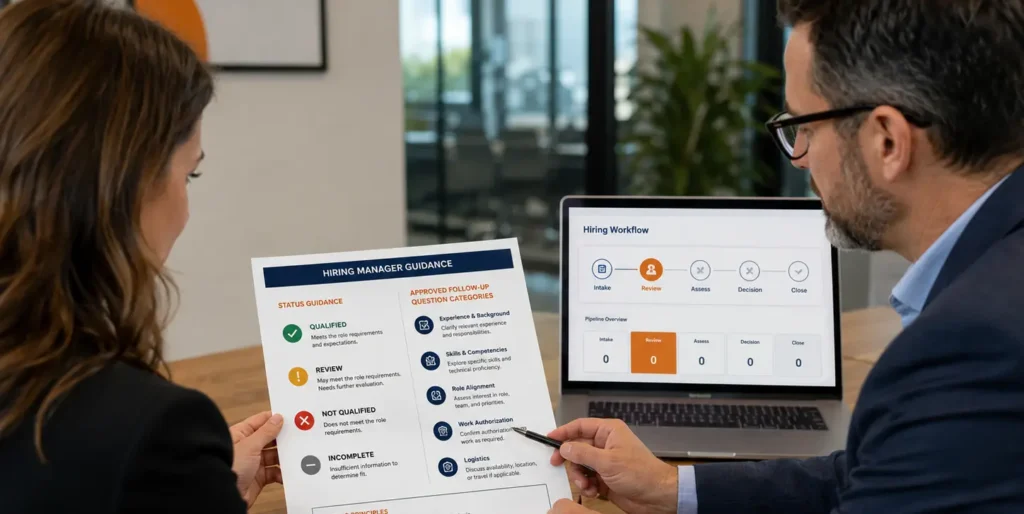
Hiring managers should understand the role of integrity screening, but they should not be left to interpret results freely. Without guardrails, one manager may treat the result as absolute. Another may ignore it because the candidate interviewed well. A third may ask unapproved follow-up questions. A better approach is to give managers controlled guidance.
| Candidate status | Manager guidance |
| Qualified | Candidate may proceed to interview |
| Review | HR is completing secondary review |
| Not qualified | Candidate will not proceed under the approved process |
| Incomplete | Candidate has not completed the required step |
If follow-up questions are appropriate, HR should provide approved structured questions.
Examples:
- “Tell me about a time you had to follow a workplace rule you did not agree with.”
- “Describe a situation where you made a mistake at work. What did you do next?”
- “Have you ever seen a coworker take a shortcut that created risk? How did you respond?”
- “Tell me about a time you had to handle company property, customer property, cash, tools, or confidential information.”
These questions should be tied to role requirements. They should not be used as informal character tests.
Use References to Confirm Patterns
References should not replace assessment data, but they can help confirm or challenge the pattern HR is seeing.
Instead of asking vague questions, use job-related trust areas:
- reliability,
- attendance,
- accountability,
- policy adherence,
- response to mistakes,
- ability to work with limited supervision,
- consistency under pressure,
- conduct with coworkers, customers, or clients.
A useful reference question might be: “Can you describe how this person handled accountability when something went wrong at work?”
Another might be: “How dependable was this person with schedule expectations, assigned responsibilities, or handoffs?”
If the assessment, interview, and references all point in the same direction, HR has a stronger basis for the decision. If they conflict, the candidate may need structured review.
Design the Process for Compliance From the Beginning
Integrity and honesty screening should be treated as part of the selection process.
That means HR should define the rules before the tool is launched.
Document:
| Compliance area | What HR should define |
| Job relevance | Why integrity screening matters for the role |
| Consistency | Which candidates receive the assessment and when |
| Result use | How result bands affect candidate movement |
| Review process | Who handles borderline results |
| Overrides | When exceptions are allowed |
| Candidate communication | How the assessment is explained |
| Data access | Who can see assessment results |
| Monitoring | How outcomes and adverse impact are reviewed |
This is not about slowing down hiring. It is about making the process explainable.
If the company ever needs to review why one candidate moved forward and another did not, the answer should not depend on memory or manager preference. It should be visible in the workflow.
For evidence and monitoring, connect this article to Data-Driven Honesty and Integrity Test for Employee Selection.
Connect the Process to the ATS
A strong integrity and honesty process should live where hiring decisions happen.
If recruiters have to leave the ATS, download reports, manually update statuses, and remember when to escalate review cases, adoption will suffer.
The ATS or hiring platform should ideally support:
- assessment invitations,
- completion tracking,
- result band visibility,
- automated recruiter tasks,
- review case routing,
- hiring manager summaries,
- documentation of overrides,
- reporting by role, location, and stage.
This is where process design becomes scalable.
The goal is not just to test candidates. The goal is to make the right next step visible to the right person at the right time.
For broader assessment infrastructure, use Talent Assessment Tools for HR Hiring and How to Implement Talent Assessment Tools in ATS Workflows.
Measure Whether the Hiring Process Is Improving
HR should not measure integrity screening only by how many candidates completed an assessment.
The better question is whether the process improves decisions.
Track:
| Metric | What it shows |
| Assessment completion rate | Candidate clarity and process friction |
| Result distribution | Whether result bands are behaving as expected |
| Review-case rate | How often secondary review is needed |
| Review resolution time | Whether review is slowing the process |
| Override frequency | Whether managers or recruiters are bypassing standards |
| Time-to-interview | Whether screening improves funnel efficiency |
| Early turnover | Whether selected candidates stay longer |
| Absenteeism | Whether reliability improves after hire |
| Policy violations | Whether conduct risk changes |
| Claims or incidents | Relevant for safety-sensitive roles |
| Hiring manager acceptance | Whether shortlists are more trusted |
| Adverse impact review | Whether the process remains fair |
Measurement should happen during pilot and after rollout.
If completion rates are low, the candidate message may need work. If review cases are too frequent, the criteria may need refinement. If overrides are common, manager alignment may be weak. If post-hire outcomes do not improve, HR should revisit role scope, timing, or decision rules.
For B3 outcome content, read How Honesty and Integrity Transform Hiring Outcomes and Honesty and Integrity Screening for Better Hiring Outcomes.
Process Map: Where Integrity Belongs
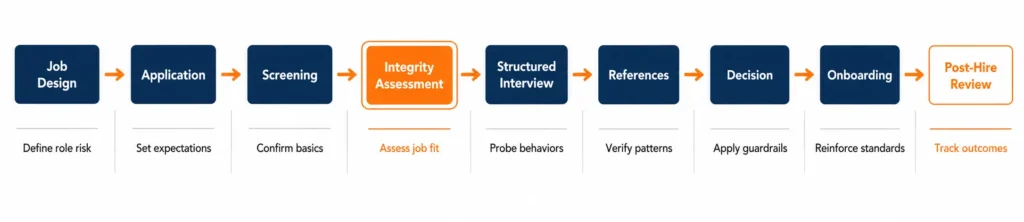
A practical integrity and honesty hiring process can be mapped like this:
| Hiring stage | Integrity and honesty action |
| Job design | Define trust, reliability, conduct, and risk expectations |
| Application | Confirm basic requirements before assessment |
| Screening | Send honesty and integrity assessment |
| Assessment review | Apply Qualified, Review, Not Qualified, or Incomplete bands |
| Recruiter screen | Use approved follow-up questions where appropriate |
| Hiring manager interview | Evaluate role-specific accountability and judgment |
| References | Look for patterns in reliability, conduct, and follow-through |
| Decision | Document result, review path, and any override |
| Onboarding | Reinforce policies, safety, attendance, and accountability expectations |
| Post-hire review | Track early turnover, absenteeism, incidents, claims, and manager feedback |
This process makes integrity visible without making hiring unnecessarily complicated.
Mistakes That Weaken the Hiring Process
Waiting Until the Final Interview
Late screening creates conflict because the hiring manager may already want the candidate.
Using Vague Integrity Language
“Must be trustworthy” is not enough. Define role-specific expectations.
Treating the Assessment as the Whole Decision
The assessment should support interviews, references, and structured review.
Giving Managers Too Much Interpretation Freedom
Managers need approved guidance, not raw reports without context.
Forgetting Candidate Experience
A confusing assessment invitation can reduce completion and damage trust.
Skipping Outcome Measurement
If HR does not measure outcomes, it cannot know whether the process is improving.
FAQ
What does integrity and honesty in the hiring process for HR mean?
Integrity and honesty in the hiring process for HR means building structured steps to evaluate trust, reliability, accountability, workplace conduct, and risk before a candidate is hired.
Where should integrity screening happen in the hiring process?
For many high-volume or risk-sensitive roles, integrity screening works best after minimum qualification review and before major recruiter or hiring manager interview time.
Should HR rely only on an honesty and integrity assessment?
No. The assessment should be one structured input. HR should combine it with role criteria, structured interviews, references, manager review, and post-hire outcome tracking.
How should recruiters explain the assessment?
Recruiters should use clear, neutral language. For example: “This short assessment helps us evaluate candidates consistently for this role.”
What should hiring managers see?
Hiring managers should receive approved summaries and next steps, such as Qualified, Review, Not Qualified, or Incomplete. They should not interpret raw assessment reports without guidance.
What outcomes should HR track?
HR should track completion rate, result distribution, review cases, overrides, time-to-interview, early turnover, absenteeism, conduct issues, claims or incidents, and adverse impact review.
Final Takeaway
Integrity and honesty should not be left to intuition at the end of the interview.
For HR, the stronger approach is to build trust into the hiring process itself. Define what integrity means for the role. Place the assessment at the right stage. Use result bands. Train recruiters. Give managers guardrails. Document decisions. Track outcomes.
That is how integrity and honesty in the hiring process for HR becomes more than a value statement. It becomes a repeatable hiring workflow.
For employers that need a focused pre-interview screen, IntegrityFirst Tests helps evaluate honesty, accountability, reliability, and workforce risk before recruiters and managers invest more time. It is especially useful for high-volume and risk-sensitive hiring environments where conduct, dependability, attendance, safety, claims, trust, and turnover create real business cost.
For companies that want that assessment connected to the broader hiring workflow, Discovered brings applicant tracking, workflows, assessments, candidate communication, scorecards, interviews, and automation into one platform.
IntegrityFirst gives HR the focused honesty and integrity signal.
Discovered gives HR the connected hiring system around it.
To reduce hiring risk with a focused integrity screen, schedule an IntegrityFirst demo.
To connect assessments with ATS workflows, scorecards, communication, interviews, and automation, book a Discovered demo.