Schedule a call!
An HR team usually starts asking about honesty and integrity testing after seeing the same hiring problem more than once.
A new hire stops showing up. A manager overlooks a conduct concern because the candidate interviewed well. A branch needs people quickly and starts applying standards unevenly. A location sees preventable turnover, claims, safety issues, theft concerns, or policy violations shortly after hire.
By then, the issue is no longer just one candidate. It is a process question.
A honesty and integrity test for HR gives employers a structured way to evaluate trust, reliability, accountability, workplace conduct, and hiring risk before a candidate moves too far into the process.
It should not replace recruiter judgment, interviews, references, or background checks. Its role is more practical: give HR a consistent signal earlier in the hiring workflow, before time and manager attention have already been heavily invested.
This guide brings together the full B2 honesty and integrity test cluster: definitions, test types, hiring workflows, candidate selection, data, leadership strategy, compliance, and where IntegrityFirst and Discovered fit in the larger hiring ecosystem.
What Is a Honesty and Integrity Test?
A honesty and integrity test is a structured pre-employment screening tool used to evaluate whether a candidate is likely to be honest, dependable, accountable, and aligned with workplace standards.
In HR terms, the test helps answer questions such as:
Can this candidate be trusted in the role?
Is the candidate likely to follow workplace rules?
Does the candidate show reliability and accountability?
Are there risk signals HR should review before moving forward?
Is this person likely to create preventable attendance, conduct, theft, safety, or policy issues?
The test is not a background check. A background check verifies historical information, depending on the type of check and legal requirements. A honesty and integrity test evaluates current attitudes, behavioral tendencies, and risk patterns that may relate to job performance and workplace conduct.
For a deeper definition and breakdown of formats, read Honesty and Integrity Test Definition and Types for HR.
Honesty vs. Integrity: Why HR Should Separate the Terms
Honesty and integrity are related, but HR should not treat them as identical.
Honesty is mainly about truthfulness. It includes accurate disclosure, avoiding deception, admitting mistakes, and representing work history or behavior honestly.
Integrity is broader. It includes honesty, but also covers dependability, accountability, judgment, rule-following, self-control, and how someone acts when there is pressure, temptation, or little supervision.
That difference matters because most employers are not trying to answer one narrow question. They are trying to understand whether a candidate is likely to meet the expectations of a real workplace.
A candidate may know that honesty is important and still rationalize small policy violations. A candidate may present well in interviews and still struggle with attendance, accountability, or safety rules after hire.
For HR, the better question is not simply, “Is this person honest?” It is: “Does this person show the reliability, judgment, and accountability this role requires?”
For a focused explanation of assessment methodology, connect this guide with Honesty and Integrity Assessment for Smarter Hiring.
Main Types of Honesty and Integrity Tests
Most honesty and integrity tests fall into three main categories. Some tools use one approach. Others combine multiple formats.

1. Overt Honesty Tests
Overt tests ask direct questions about workplace honesty, theft, attendance, drug use, rule-following, safety, or conduct.
These tests may explore:
- attitudes toward theft,
- past behavior admissions,
- views on rule-breaking,
- reactions to coworker misconduct,
- attendance and reliability patterns,
- willingness to follow policies.
The advantage is clarity. The candidate understands what is being asked, and HR can more easily connect the content to workplace risk.
The limitation is that candidates may try to answer in the way they believe the employer wants.
Overt honesty tests are often useful in high-volume hiring environments where employers need a fast, practical risk screen before interviews or placement.
2. Personality-Based Integrity Tests
Personality-based integrity tests are less direct. They may evaluate traits related to conscientiousness, dependability, impulse control, responsibility, emotional stability, rule orientation, and accountability.
The advantage is that the intent behind each question is less obvious, which can reduce simple response management.
The limitation is interpretation. If the output is complex, recruiters may not know what to do with the result.
These tests work best when HR has clear guidance, trained users, and a defined decision workflow.
3. Situational or Scenario-Based Tests
Situational tests ask candidates how they would respond to realistic workplace scenarios.
Examples may involve:
- reporting a mistake,
- following a safety rule under time pressure,
- handling a coworker who breaks policy,
- dealing with customer property,
- deciding whether to take a shortcut,
- responding when a supervisor is not present.
The advantage is practical relevance. Hiring managers can often understand these results because the scenarios resemble workplace decisions.
The limitation is that scenarios need to match the role. A question built for retail may not apply to logistics, healthcare support, construction, or manufacturing.
Which Test Type Should HR Use?
There is no universal best format.
The better choice depends on the role, hiring volume, risk exposure, candidate experience, and how recruiters will use the result.
| Test type | Best fit | Watch-out |
|---|---|---|
| Overt honesty test | Clear screening for frontline or high-volume roles | Candidates may answer favorably |
| Personality-based integrity test | Broader dependability and conduct risk signals | Requires interpretation discipline |
| Situational integrity test | Role-specific judgment and policy scenarios | Must reflect real job conditions |
| Blended model | Employers that want a more complete risk signal | Still needs simple result bands |
A blended approach is often useful because workplace risk rarely appears in only one form. Honesty, dependability, accountability, and judgment tend to overlap in real hiring situations.
For a deeper category overview, read What Is an Honesty Integrity Test for HR.
What Honesty and Integrity Tests Can Help HR Evaluate
A well-designed test helps HR evaluate workplace risk that is difficult to see in resumes or short interviews.
Common areas include:
| Area | Why it matters |
| Reliability | Attendance, follow-through, schedule dependability |
| Accountability | Whether candidates take responsibility or shift blame |
| Rule-following | Alignment with safety, conduct, and workplace policies |
| Honesty | Truthfulness and accurate disclosure |
| Theft or misuse risk | Relevant for roles with cash, inventory, tools, or client property |
| Safety shortcuts | Important in field, logistics, construction, and manufacturing roles |
| Workplace conduct | Helps identify preventable conflict or disciplinary concerns |
| Dependability under pressure | Useful when employees work with limited supervision |
The test should not be framed as a guarantee. It is one structured input that helps HR identify risk earlier and apply standards more consistently.
For the data-first angle, read Data-Driven Honesty and Integrity Test for Employee Selection.
Where a Honesty and Integrity Test Belongs in the Hiring Process
Timing affects whether the test is useful.
If the test happens too early, HR may assess candidates who do not meet basic requirements. If it happens too late, hiring managers may already be invested in a candidate and more likely to discount risk signals.
For many high-volume and risk-sensitive roles, the best placement is:
Application received
Minimum qualifications reviewed
Honesty and integrity test sent
Candidate completes the test
Result appears in the hiring workflow
Qualified candidates move forward
Review candidates receive structured review
Not qualified candidates follow the approved disposition process
This placement keeps the test early enough to shape the shortlist, but not so early that it creates unnecessary friction for every applicant.
For a step-by-step operational guide, use How to Use Honesty and Integrity Tests in Hiring.
How to Use Test Results in Candidate Selection
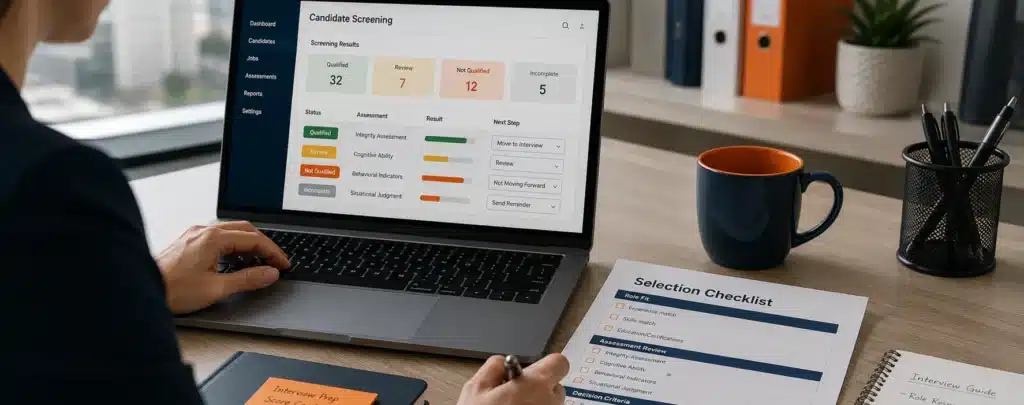
A test result should not be a vague score sitting in a separate platform.
HR needs decision-ready outputs.
A practical model uses result bands:
| Result band | Meaning | HR action |
| Qualified | Candidate meets the defined standard for the role | Continue to next step |
| Review | Risk signals require a structured second look | Apply approved review criteria |
| Not qualified | Candidate does not meet the role standard | Follow approved disposition process |
| Incomplete | Candidate did not finish the test | Send reminder or close after deadline |
The “Review” band is especially important. Hiring is not always binary. A review path gives HR a way to handle nuance without allowing each recruiter or manager to create a different standard.
That review path should define:
- who reviews the result,
- what information may be considered,
- how long the review should take,
- when an exception is allowed,
- where the final decision is documented.
For a selection-specific framework, read Honesty and Integrity Tests for Candidate Selection.
How Recruiters Should Explain the Test to Candidates
Candidate communication should be direct and neutral.
A simple message works best:
“Please complete this short pre-employment assessment as the next step in your application. It helps us evaluate candidates consistently for this role and can be completed from any device.”
That is enough for most hiring workflows.
Avoid language that sounds punitive or moralistic, such as:
“This test decides if you are honest.”
“We use this to catch risky candidates.”
“You must prove your integrity before continuing.”
The goal is to create a clear hiring step, not to make candidates feel accused.
Recruiters should be trained on one consistent explanation. Candidate experience suffers when every recruiter explains the assessment differently.
What HR Leaders Should Decide Before Launch
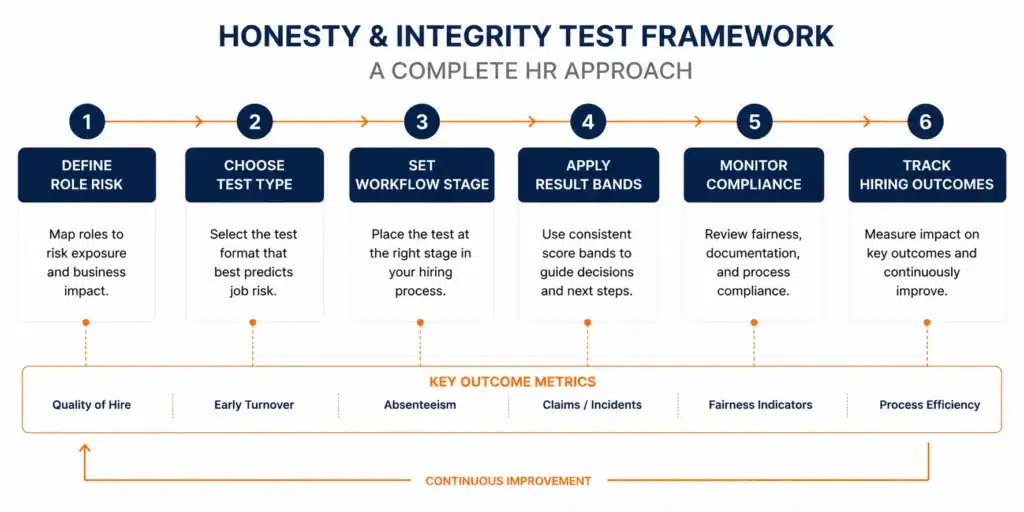
A honesty and integrity test becomes much easier to manage when leadership decisions are made before the first candidate takes it.
HR should define:
| Decision area | What to decide |
| Role coverage | Which job families receive the test |
| Stage placement | When the test appears in the workflow |
| Candidate messaging | How the test is explained |
| Result bands | What each outcome means |
| Review ownership | Who handles borderline cases |
| Overrides | When exceptions are allowed |
| Data storage | Where results are stored |
| Reporting cadence | How outcomes are reviewed |
| Success metrics | What the program is expected to improve |
Without these decisions, the test may be technically launched but operationally weak.
For a leadership-level view, read Honesty and Integrity Test Strategy for HR Leaders.
Compliance and Fairness Considerations
Honesty and integrity tests should be treated as employment selection tools.
That means HR should use them carefully, consistently, and with documentation.
Before launch, HR should confirm:
- the test is job-related,
- the same process applies to similarly situated candidates,
- result bands are defined,
- review rules are documented,
- recruiters are trained,
- candidate communication is clear,
- data access is limited,
- overrides are documented,
- outcomes are monitored,
- adverse impact is reviewed where appropriate.
The compliance goal is not to make the process slow. It is to make the process explainable.
A test used consistently is easier to defend and easier to improve than a test used differently across locations, recruiters, or managers.
What Data HR Should Track
The test program should be measured by decision quality, not by the number of assessments sent.
Useful metrics include:
| Metric | Why it matters |
| Invitation rate | Confirms the workflow is being applied |
| Completion rate | Shows whether candidates can complete the step easily |
| Time to completion | Reveals candidate friction |
| Qualified / Review / Not qualified distribution | Shows how results move through the funnel |
| Review-case resolution time | Measures whether review is creating bottlenecks |
| Override frequency | Reveals pressure, confusion, or misalignment |
| Recruiter adoption | Shows whether the process is being used |
| Time-to-interview | Measures recruiting efficiency |
| Early turnover | Tracks post-hire quality |
| Absenteeism | Useful for frontline and shift-based roles |
| Claims or incidents | Relevant for risk-sensitive environments |
| Adverse impact review | Supports fairness monitoring |
The best question after launch is not “Did we send the test?” It is “Did the test help us make more consistent hiring decisions?”
For a deeper evidence and KPI model, use Data-Driven Honesty and Integrity Test for Employee Selection.
How to Build a Simple Rollout Plan
A good rollout does not need to start across the entire company.
Start with one role family where honesty, reliability, and workplace risk are clearly relevant.
A practical pilot plan includes:
- Choose the role family.
- Confirm minimum qualification requirements.
- Define when the test is sent.
- Write candidate messaging.
- Set result bands.
- Assign review ownership.
- Train recruiters.
- Align hiring managers.
- Track baseline metrics.
- Review outcomes after launch.
During the pilot, pay attention to friction.
If candidates are confused, rewrite the invitation.
If recruiters bypass the process, fix the workflow.
If review cases pile up, clarify ownership.
If managers ignore results, simplify the summary.
If overrides are common, revisit the decision rules.
A pilot should test the full operating model, not just the assessment.
Common Mistakes HR Should Avoid
Treating the Test as a Standalone Decision: A honesty and integrity test should support hiring decisions, not replace all other selection inputs.
Applying One Standard to Every Role: Different roles carry different integrity and reliability risks. Role families should be grouped thoughtfully.
Testing Too Late: Late testing often creates conflict because managers may already want the candidate.
Giving Recruiters a Score Without a Next Step: Recruiters need result bands, review rules, and approved candidate communication.
Letting Hiring Managers Interpret Reports Freely: Managers should receive approved summaries, not uncontrolled report access or informal character interpretations.
Ignoring Candidate Experience: A confusing or intimidating invitation can reduce completion and damage trust.
Measuring Activity Instead of Outcomes: Assessment volume is not the goal. Better hiring outcomes are.
FAQ
What is a honesty and integrity test for HR?
A honesty and integrity test for HR is a structured pre-employment screening tool used to evaluate honesty, dependability, accountability, rule-following, and workplace risk before a hiring decision is made.
What does a honesty and integrity test measure?
It may measure truthfulness, reliability, accountability, attitudes toward workplace rules, dependability, conduct risk, and behavioral patterns related to counterproductive workplace behavior.
When should HR use a honesty and integrity test?
For high-volume or risk-sensitive roles, HR often uses the test after minimum qualification review and before recruiter or hiring manager interviews.
Should the test automatically reject candidates?
Not always. Some workflows use defined cutoffs, but many employers benefit from a Review band that allows structured secondary review before final disposition.
Is a honesty and integrity test the same as a background check?
No. A background check verifies past records or credentials depending on the check. A honesty and integrity test evaluates current attitudes, tendencies, and risk patterns related to workplace behavior.
What roles benefit most from honesty and integrity testing?
These tests are especially useful for staffing, construction, logistics, healthcare support, manufacturing, retail, hospitality, transportation, warehouse, field, and other roles where reliability, safety, attendance, conduct, or trust matter.
How should HR evaluate a test vendor?
HR should ask what the test measures, which roles it fits, what validation evidence is available, how results are interpreted, how adverse impact is monitored, and how the test fits into the hiring workflow.
Final Takeaway
A honesty and integrity test works best when HR treats it as part of the hiring operating model, not as a disconnected screening step.
The test should have a clear purpose, a clear place in the workflow, clear candidate communication, defined result bands, trained recruiters, documented review rules, and outcome tracking.
For employers that need a focused pre-interview screen, IntegrityFirst Tests helps evaluate honesty, accountability, reliability, and workforce risk before recruiters and managers invest more time. It is especially useful for high-volume and risk-sensitive hiring environments where conduct, dependability, attendance, safety, claims, and turnover create real business cost.
For companies that want that assessment connected to the broader hiring process, Discovered brings applicant tracking, workflows, assessments, candidate communication, scorecards, interviews, and automation into one platform.
IntegrityFirst gives HR the focused honesty and integrity signal.
Discovered gives HR the connected hiring system around it.
To reduce hiring risk with a focused integrity screen, schedule an IntegrityFirst demo.
To connect assessments with ATS workflows, scorecards, communication, interviews, and automation, book a Discovered demo.