Schedule a call!
This pre-hiring assessment tools guide for HR is for teams that know interviews alone are not enough, but do not want to add another piece of software that recruiters ignore after the first month.
That is the real buying challenge.
Most HR teams are not short on tools. They are short on clean signals before the interview: who is reliable, who has the right skills, who is likely to fit the job, and who should not move forward before the company spends more time, money, or manager attention.
Pre-hiring assessments help answer those questions earlier. But the right tool depends on the hiring problem. Integrity screening, technical testing, ATS workflow, coding evaluations, and recruiting automation are not the same thing.
Use this guide as the starting point. For a deeper vendor comparison, read Best Easy-to-Integrate Pre-Hiring Assessment Tools Compared. For implementation after selection, use How to Implement Talent Assessment Tools in ATS Workflows.
The Short Version for Busy HR Teams
A good pre-hiring assessment tool should help HR do five things better:
| HR question | What the assessment should clarify |
| Is this candidate worth interviewing? | Early job-fit or risk signal |
| Can this person do the work? | Skills, work sample, or technical evidence |
| Will this person be reliable? | Integrity, dependability, safety, or conduct risk |
| Can recruiters use the result quickly? | Clear score, status, or recommendation |
| Can HR defend the process? | Job-related, consistent, documented workflow |
The best tool is not always the biggest platform. It is the one that fits the role, the hiring volume, the recruiter workflow, and the level of risk in the job.
What Are Pre-Hiring Assessment Tools?
Pre-hiring assessment tools are structured screening tools used before a hiring decision is made. They can measure skills, job knowledge, cognitive ability, personality traits, integrity, communication style, work behavior, or role-specific judgment.
They are different from interviews because they create a more consistent data point across candidates.
The EEOC notes that employers commonly use tests and selection procedures in hiring, including cognitive tests, personality tests, medical examinations, credit checks, criminal background checks, work samples, and integrity tests. It also warns that these tools must be used carefully because they can raise legal issues if they discriminate or disproportionately exclude protected groups without proper justification. EEOC employment tests and selection procedures guidance. (eeoc.gov)
That is why HR should choose assessments by job need, not by vendor popularity.
Start With the Hiring Problem
Before comparing platforms, define the hiring issue in plain language.
- Are recruiters interviewing too many weak-fit candidates?
- Are frontline roles seeing early turnover?
- Are managers relying too much on gut feel?
- Are technical screens taking too long?
- Are assessment results scattered outside the ATS?
- Are hiring decisions inconsistent across locations?
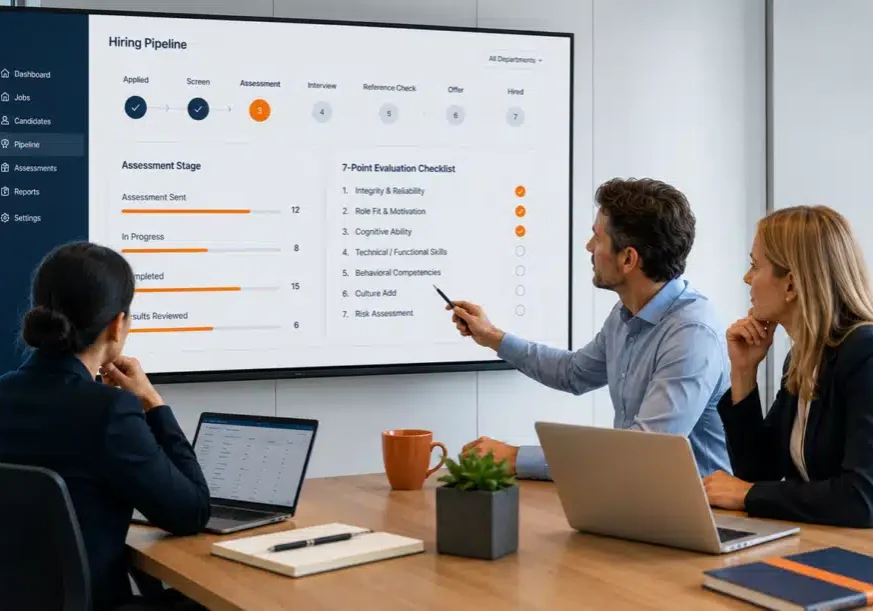
The answer points to a different type of tool.
| Hiring problem | Better tool category |
| Early turnover, theft, absenteeism, conduct risk | Integrity or reliability assessment |
| Too many unqualified applicants | Pre-screening and knockout workflow |
| Technical hiring bottlenecks | Coding or technical assessment |
| Inconsistent manager evaluation | Structured scorecards and interview guides |
| Disconnected candidate data | ATS or hiring platform |
| Role-specific skill uncertainty | Work sample or custom skill test |
The U.S. Office of Personnel Management recommends that assessment strategy begin with the critical competencies identified through job analysis, then determine which tools and sequence fit the hiring process. OPM assessment strategy guidance. (U.S. Office of Personnel Management)
Main Types of Pre-Hiring Assessment Tools
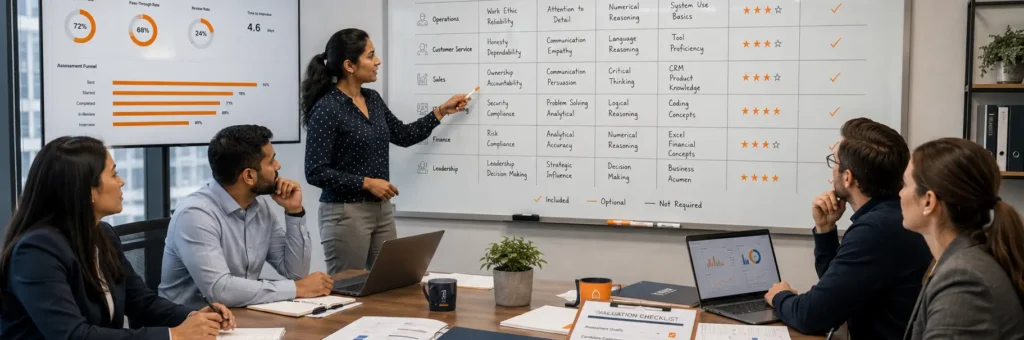
Most HR teams need one or more of these categories.
Integrity and Reliability Assessments
Integrity assessments help employers evaluate risk factors tied to honesty, dependability, workplace conduct, safety, absenteeism, theft, and policy adherence.
They are especially useful in high-volume, frontline, staffing, logistics, retail, healthcare support, hospitality, manufacturing, transportation, and construction roles.
For a deeper integrity-focused explanation, read Integrity Assessment for Employee Screening. For honesty-focused screening, see Honesty Test for Employee Screening.
Skills and Job Knowledge Tests
Skills tests confirm whether a candidate can perform job-related tasks. These may include data entry, customer service scenarios, writing samples, sales exercises, accounting tests, or job knowledge checks.
They work best when the role has measurable tasks and HR can clearly explain why the test reflects the job.
Cognitive and Aptitude Assessments
Cognitive assessments measure reasoning, learning ability, problem-solving, numerical ability, verbal reasoning, or attention to detail.
They can be useful, but HR should be careful with job relevance, cutoff scores, and adverse impact review.
Technical and Coding Assessments
Technical assessments are common in software engineering, data, cybersecurity, QA, and other technical roles. These tools help teams evaluate real skills before committing senior engineering time to interviews.
For broader ATS-connected tool selection, see 7 Best Talent Assessment Tools That Integrate With ATS.
Structured Interview and Scorecard Tools
Some pre-hiring tools are less about testing and more about standardizing evaluation. Scorecards, interview guides, and structured feedback forms help hiring managers compare candidates consistently.
This is where a full hiring platform may be more useful than a single test.
Vendor Fit: IntegrityFirst, Greenhouse, Lever, HackerRank, and Codility

This article is not trying to rank these tools as if they solve the same problem. They do not.
A better question is: Where does each one fit in the hiring stack?
| Tool | Best fit | Where it helps most |
| IntegrityFirst | Integrity, reliability, conduct, and workforce risk screening | Before recruiter or manager interviews |
| Greenhouse | ATS, structured hiring, integrations, enterprise recruiting workflow | Managing the hiring process and connected tools |
| Lever | ATS + CRM, candidate relationship management, automation, analytics | Recruiting teams that need pipeline nurturing and workflow visibility |
| HackerRank | Developer screening, coding tests, technical skills assessment | Before technical interviews |
| Codility | Technical screening and engineering assessment workflows | Engineering hiring and coding evaluation |
IntegrityFirst
IntegrityFirst is the strongest fit when the hiring problem is not just skill, but risk.
If a poor hire can create absenteeism, safety issues, theft risk, turnover, policy violations, or client trust problems, integrity screening belongs earlier in the funnel.
IntegrityFirst public materials state that the assessment takes under 8 minutes, delivers instant results, and integrates with ATS, VMS, staffing, or hiring platforms depending on the use case. (integrityfirsttests.com)
Greenhouse
Greenhouse is a broader applicant tracking and hiring platform. It is useful when the company needs structured hiring, workflow control, reporting, candidate experience tools, and a large integration ecosystem.
Greenhouse states that its platform includes hiring workflows, interviewing and decision-making, reporting, AI recruiting, and hundreds of pre-built integrations. (greenhouse.com)
Use Greenhouse when the main problem is process structure, not one specific assessment type.
Lever
Lever combines ATS and CRM capabilities. It is useful for teams that need to manage applicants, nurture passive candidates, automate workflows, collaborate with hiring managers, and measure hiring performance.
Lever describes itself as a modern ATS and recruiting CRM for growing and enterprise teams, with automation, analytics, collaboration, and candidate relationship management in one platform. (Lever)
Use Lever when relationship management and pipeline visibility are as important as applicant tracking.
HackerRank
HackerRank is built for technical skills assessment. It helps teams send coding assessments, evaluate technical ability, and return structured results to the hiring workflow.
HackerRank states that Screen connects with ATS and HRIS tools such as Greenhouse, Lever, Workday, and others so assessments can be triggered, tracked, and evaluated without adding a new workflow. (hackerrank.com)
Use HackerRank when the hiring question is: “Can this candidate demonstrate the technical skill before an interview?”
Codility
Codility is also focused on technical assessment and engineering hiring. It is a better fit when hiring teams need coding tests, structured technical screening, and integrations with HR tools.
Codility positions its platform around technical skills assessment and states that it integrates with HR tech partners and applicant tracking systems. (Codility)
Use Codility when engineering screening quality and technical workflow matter most.
How to Choose the Right Tool by Hiring Scenario
Here is a practical way to think about selection.
| Scenario | Better first choice |
| High-volume frontline hiring with turnover or conduct risk | IntegrityFirst |
| Company needs a full ATS with structured workflows | Greenhouse |
| Recruiting team needs ATS + CRM and candidate nurturing | Lever |
| Engineering team needs coding assessments | HackerRank or Codility |
| HR wants assessments, ATS, scorecards, automation, and workflows together | Discovered |
| Team already has an ATS but needs a fast integrity screen | IntegrityFirst |
For teams specifically focused on simple rollout and integration ease, use Easy-to-Integrate Pre-Hiring Assessment Tools. For a checklist-style buying process, use 7 Easy-to-Integrate Pre-Hiring Assessment Tools for HR.
What HR Should Check Before Buying
Before signing with any vendor, ask for a live walkthrough using one real role from your company.
Do not ask, “Can you integrate with our ATS?”
Ask:
- Show us how the assessment is sent.
- Show us what the candidate sees.
- Show us how long it takes.
- Show us what the recruiter sees.
- Show us what the hiring manager sees.
- Show us where the result is stored.
- Show us how exceptions are documented.
- Show us how different roles get different assessments.
- Show us what compliance support is available.
A vendor that cannot answer in workflow language may create work for your recruiters later.
What Good Implementation Looks Like
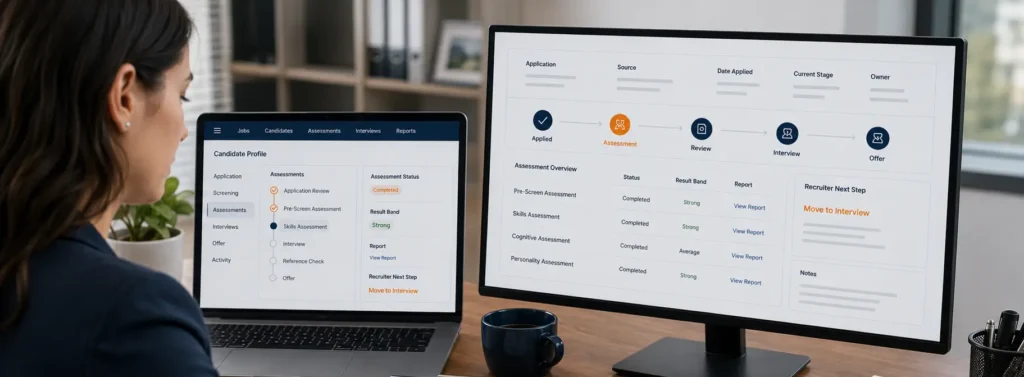
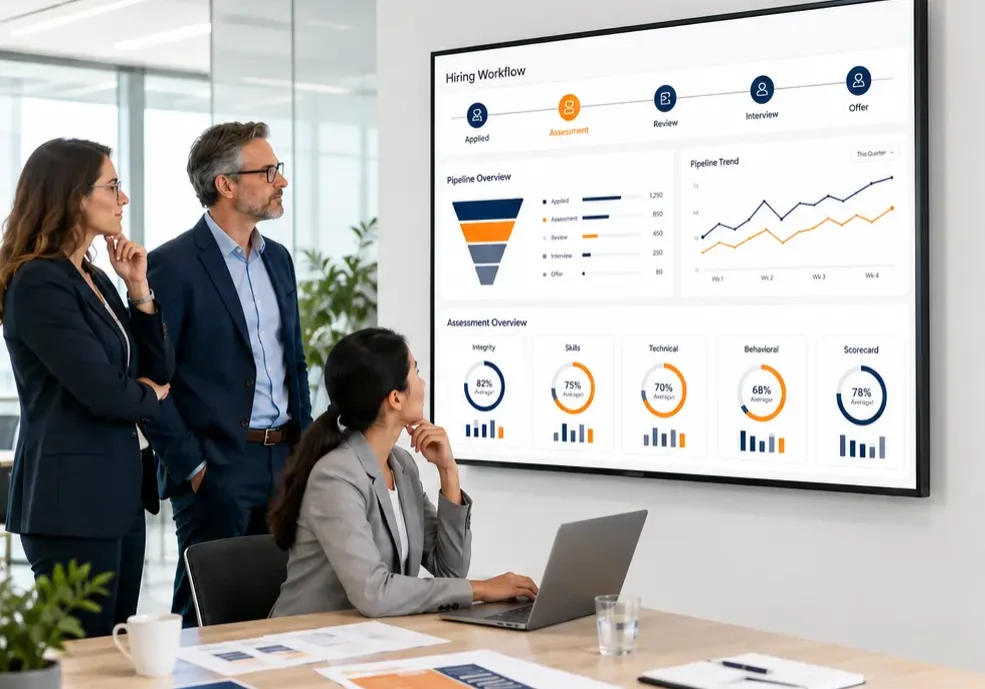
A clean pre-hiring assessment workflow usually looks like this:
- Candidate applies.
- Minimum qualifications are reviewed.
- The right assessment is triggered.
- The candidate completes it.
- Results return to the hiring workflow.
- Recruiter sees the next step.
- Hiring manager reviews a stronger shortlist.
- HR can audit the process later.
That does not mean every candidate should be automatically rejected by a score. In many cases, the best workflow includes a review band, especially when the result needs context.
OPM also recommends standardizing and documenting assessment processes, treating individuals consistently, using up-to-date job analysis, and helping applicants understand the rationale for the assessment process. (U.S. Office of Personnel Management)
Where Discovered Fits in the Stack
Discovered matters because some companies do not want to keep stitching tools together.
A team may start with one need: integrity screening, technical testing, candidate communication, interview scheduling, scorecards, or applicant tracking. Over time, those needs turn into a connected hiring system.
Discovered positions its platform as AI-powered hiring software for recruiting, assessing, and retaining talent. Its site lists applicant tracking, workflow management, candidate assessments, custom skill tests, scorecards, interview scheduling, and hiring automation as part of the broader hiring ecosystem. (Discovered.ai)
Discovered’s assessment software page also describes pre-employment assessments for skills, traits, job fit, cognitive ability, integrity, leadership potential, work skills, and custom skill assessments, with automated invites and instant reports. (Discovered.ai)
That makes Discovered the stronger fit when HR wants more than a point solution.
Common Mistakes to Avoid
- The first mistake is buying a tool before defining the hiring problem.
- The second is using one assessment for every role.
- The third is placing a long assessment too early in the funnel.
- The fourth is sending results to recruiters without clear next steps.
- The fifth is assuming “integration” means the same thing across vendors.
A secure link, ATS integration, API connection, and full platform workflow are different levels of operational maturity. HR should choose the lightest setup that solves the problem today, without blocking growth later.
FAQ
What is a pre-hiring assessment tools guide for HR?
A pre-hiring assessment tools guide for HR helps talent acquisition teams understand assessment categories, vendor fit, ATS workflow, compliance considerations, and how to choose the right tool before interviews or final hiring decisions.
What are the most common types of pre-hiring assessments?
The most common types include integrity assessments, skills tests, cognitive assessments, personality or behavioral assessments, technical coding tests, work samples, structured interviews, and scorecards.
Should every company use the same assessment tool?
No. A high-volume staffing team, an engineering hiring team, and an enterprise recruiting team have different needs. The assessment should match the role, risk level, hiring volume, and workflow.
Where should IntegrityFirst sit in the hiring process?
IntegrityFirst usually fits early in the funnel, after minimum qualifications and before recruiter or hiring manager interviews. That placement helps teams identify reliability and workforce risk before more time is invested.
Is Discovered an assessment tool or a hiring platform?
Discovered is broader than a single assessment tool. It brings applicant tracking, assessments, scorecards, workflows, communication, and automation into a connected hiring platform.
Final Takeaway
The strongest HR teams do not buy pre-hiring assessments because they want more reports. They buy them because they need better hiring signals before the interview.
That is the purpose of this pre-hiring assessment tools guide for HR: to help teams separate the tool category from the business problem.
If your biggest concern is integrity, reliability, conduct, absenteeism, safety, turnover, or workforce risk, IntegrityFirst Tests is built for the pre-interview stage. It gives HR teams a fast way to screen for risk before recruiters and hiring managers spend more time with a candidate.
If your team wants the larger hiring system around that assessment, Discovered brings the workflow together: applicant tracking, assessments, custom skill tests, scorecards, communication, interview tools, and recruiting automation.
IntegrityFirst gives you the focused integrity signal. Discovered gives you the connected hiring ecosystem.
To reduce hiring risk with a fast integrity screen, schedule an IntegrityFirst demo.
To connect assessments with ATS workflows, scorecards, interviews, and automation, book a Discovered demo.